
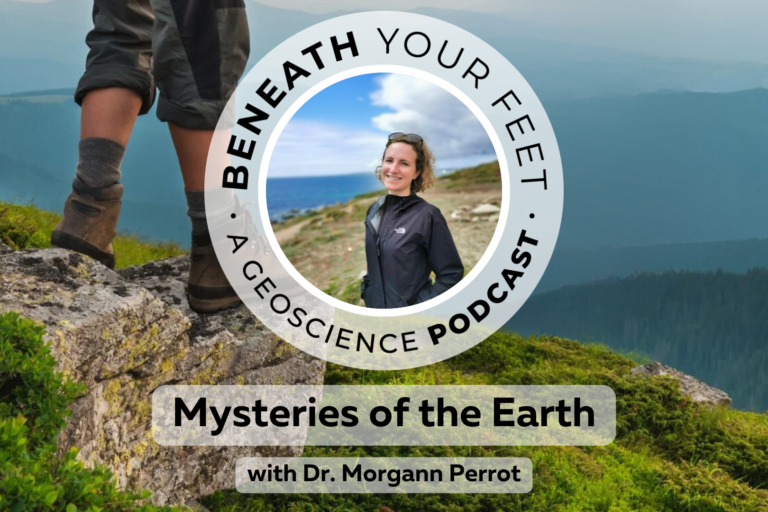
Perrot was never a hiker – she preferred to stay indoors thank you very much. It was much to her parents surprise (and hers!), when she discovered she loves geology. Her love of thriller books and murder mysteries first led her to study medical science, but she wasn’t satisfied. When she found geoscience and learned you can use science to solve mysteries of the earth, she knew that’s where she belonged.
Now, Dr. Perrot explores the Appalachian mountains in the summertime, doing as much field work research as possible, and lecturing at McGill University during the rest of the year. Every day is different, and she loves the variety. Tune in to learn more about Perrot’s research and journey!
Listen now:
You can also listen to our podcast on these platforms:
Read along with the podcast transcript:
Introduction
Hello, everyone. Welcome to Beneath Your Feet, a geoscience podcast. I’m Veronica Klassen, science communicator, geology enthusiast and your host. Here at the APGO Education Foundation, our mission is to spark curiosity and passion for the geology of Ontario. Whether you’re a geology nerd, science enthusiast, or nature lover, this podcast is for you. Join us as we geek out over fascinating geology, uncover the hidden stories
and secrets of our extraordinary planet and explore the captivating world beneath your feet.
Veronica Klassen
Hello, everyone, and welcome to another episode of Beneath Your Feet. Today I am here with Dr. Morgann Perrot, who is a faculty lecturer at McGill University. She studies how the Earth’s crust deforms, breaks and builds mountains with a special interest in the northern Appalachians. She combines fieldwork with isotope geochemistry to piece together the tectonic history hidden in rocks. As a dedicated educator, she brings her research and field experience directly into the classroom, teaching, field mapping and structural geology related courses. I’m so excited that you’re here today with me, Dr. Morgan.
Dr. Morgann Perrot
Hi, Veronica. It’s nice to be here with you.
Veronica
So first question, just tell us a bit about yourself. Who are you and what do you do?
Morgann
Well, I think you did a good synthesis of what I’m doing and that. So, yeah, I’m a lecturer at McGill University. I’m teaching structural geology, geology in the field. So also a field course about geology. So it’s a lot of geology courses that are linked to going outside, understanding rocks, how they deform when they are under pressure and stress and trying to understand this.
And so this is linked to the how mountains are forming and deforming, actually. I’m teaching these courses and on the side I’m also doing some research about deformation too. So looking at how rocks will fold, crack. When do they do that? Looking at around us if we see some deformation and when did that happen? Because the earth is quite old, more than 4.5 billion years old. So some rocks have been deformed for billions of years. Some rocks are deforming just right now under our feet. So yeah, the question is when did that happen and why? So that’s the question I’m trying to answer.
Veronica
Okay, that sounds super interesting. So what does a day in the life look like for you?
Morgann
I guess it really depends on the season, and that’s what I like about my job. Over a year things really change. So for example, during summer I’m going to do more fieldwork, I’m going to go outside. Especially being a researcher in Canada doing fieldwork, looking at rocks during winter, it’s not really possible. Well, especially because my research is also in Canada mostly, so when there is a lot of snow, it’s not really easy. So yeah, we’re doing field work mostly in the summer, so I concentrate my summers doing research, going outside in the fields, but also bringing back rocks in the lab and doing lab work.
During fall and winter, I’m more teaching so I’m more in McGill with students, so I’m doing a lot of courses relating to going outside too. So we’re trying to deal with the weather. So when it’s nice weather, we’re going outside in the field. When it’s more snowy or cold, we stay inside and do more theoretical lectures, you know? So every day I’m going to do a bit of, you know, reviewing articles for colleagues, for other students, helping students to look at their thesis, master thesis, PhD thesis. Doing some tasks in the department and some colleagues need some help and support and yeah things like that.
What’s fun is that there was not one day where I do the same thing, so I can’t really describe a really ideal day, you know, it changes everyday.
Veronica
Right? Yeah, Yeah. There’s a lot of variety that’s awesome. And so are you doing your own research as well or you just like supervising research? How does that all work?
Morgann
Yeah, so my main job as a lecturer is to teach. So I teach most of the semester, every semester, but on the side I’m also involved in some research projects. So it depends. There is some projects that I lead myself for myself mainly for my own interest, but there is also some project in which I’m involved with students for their masters thesis, for their PhD thesis. I’m not the principle supervisor of students at the moment. I just started at McGill. But I’m involved as collaborator in projects like this.
I also, so what I’m trying since I started in McGill is to, every summer have an undergrad student working with me to do some initiation, to research, to be in the field, to do a bit of lab work. And I find this very important for students to discover really early on what is research and do they want to continue into masters or not, or into PhDs or not?
Veronica
Yeah, that’s really awesome and I think really useful for students hopefully to figure out what they want to do. If you don’t mind me asking what is the research that you’re doing for your own interest? Would you say that you have like a specific niche that you enjoy studying or, yeah, something in particular that you’re really interested in?
Morgann
So I could define myself as an Appalachian geologist.
Veronica
Okay, yeah.
Morgann
What is Appalachians? They are a mountain belt that is on the east coast of Canada and the US, North America. And so for my masters, PhD, and even during my postdoc, I studied these rocks like some of the information that was linked to the formation of this mountain belt. And so I’m really passionate about the history of these rocks and looking at how, when the Appalachians formed. Yeah, that’s my niche, so I’m continuing to look into this.
Recently I’ve been involved in a project where I’m looking at the post-Appalachian deformation around Montreal. And so looking at during the opening of the Atlantic, how have the rocks around Montreal behaved? And so actually there is a lot of fractures and faults and we’re trying to understand how these faults formed and why. And this is actually very important for the engineering side for the city of Montreal, because when you are digging a channel for a metro station, for example, when you’re building a bridge, you want to make sure that there is no faults there or if there is a fault that it’s stable, you know, that you have put in place enough security check to make sure that it will not move or collapse.
So, yeah, that’s pretty useful. So what we’re doing, it’s like really trying to map and to understand better this fracturation around Montreal. I don’t want to worry anyone, these faults are pretty stable. It’s just that for planning, for urban purposes, it’s useful to plan it before to know that, oh, there going to be a fault here, so we have to take that into account instead of having take it into account afterwards, when you start to build a hole and be like, Oh, oh no, there is a fault, we need to redo all our calculations to account for it, right?
So it’s very fun project. I like that it links my research into understanding why this fault are here, but also the public interest and the citizens for trying to be more efficient with urban planning.
Veronica
Yeah, that’s super important because yeah, it’s obviously a lot more difficult to go back and change things rather than to have the information before you start.
Morgann
Yeah, yeah, it takes longer. And so when we say longer, it means more money.
Veronica
Yes. Exactly. Exactly.
Morgann
More tax money.
Veronica
Yeah. And so you’re here now studying the Appalachian Mountains and the rocks around Montreal. But going back, did you always know that you wanted to be a geologist or professor? How has your journey with geoscience kind of changed over time?
Morgann
Actually, I didn’t always want to be a geologist. For a long time I didn’t know it existed. As a child I wanted to do medicine. I was fascinated by thrillers movies, thrillers books. The legal medicine in them and things like that was fascinating to me. But I think it was more the looking for clues and the search for answers that was triggering me.
And so during my high school I discovered earth sciences and I really liked it. I thought it was fascinating. It was easy for me. I liked that it was kind of logical for me. So yeah, but at that time I was not ready to give up my medical passion. And so I went to medical school after high school.
But after two years of intense biology and anatomy, I actually thought that I needed something else. And I rethought about what I liked and I thought about earth science, and I was like, hm, maybe this is more for me. And yeah, I give it a real chance by going into earth science at the university in France, in Nice. And I loved it. I never looked back.
Yeah, that’s when I really thought about, what do I like, you know? More than, what do I know about jobs? I think that was the thing. It’s something geology, I didn’t know about it, but by knowing that I liked this kind of science, that I liked science, but finally, yeah, I was more into understanding processes than, in medical school, it was more like just learning a lot of things by heart. And I guess at the beginning of my study it was less of going into those processes. When I did the switch to earth sciences, I discovered a total new way of thinking about the earth. And I think that like that.
And by year two, I actually had a prof who drew the Oman Ophiolite. It’s a piece of the ocean floor that is exposed in Oman and this prof just drew this on a blackboard while explaining to us students its formation. I just thought that was so cool. And I just thought, okay, I want to do that. I want to understand why there is this piece of ocean, not in the ocean anymore, you know?
Veronica
Yeah. That’s so cool. And you grew up in France, right?
Morgann
Yeah.
Veronica
How did you end up in Canada?
Morgann
By my third year of Bachelor, I did an exchange actually with UQAM, University of Quebec in Montreal. I was 21 year old. I thought, okay, I want to explore the world a bit. Honestly, at the time I was not speaking very much English, so I thought, okay, let’s try to find a French university where I can pursue my studies without… I was scared to lose my level and because I already knew that I wanted to push towards like Master and maybe Ph.D.. And in France, for example, it’s very competitive to get into the PhD. I was really worried to lose my level if I was going to study in a university where I didn’t understand everything. You know, I was afraid that if I missed like even 10% of the information, that would not be enough.
So yeah, so I looked for a French university and I ended up in Quebec to finish my third year of Bachelor. And then here I met a prof who became my masters supervisor, and then my PhD supervisor, Alain Tremblay, who is a specialist of the Appalachians. And so, yeah, so I stayed because he had good projects for me. And so it went very well.
Veronica
So that’s so cool. And was it very different, like the school system in France versus Canada? I’m just curious.
Morgann
Yeah, Yeah. And that’s part of why I stayed. Actually to do a master project here. Because here masters projects, you are running a project for two years. You are the leader of your project for two years. However, in France it’s like more… well it was at the time, I don’t know if it’s like this anymore… but it was more like three months internship for the first year and then six months for the second year of your masters.
Veronica
Interesting.
Morgann
Yeah, but they are pretty intense internships, so you learn a lot too. But I thought if I want to do a PhD, which is a kind of 3 to 4 years project, that you’re leading by yourself, I wanted to know if I was capable to lead a project for two years in a row, you know, and not being tired of it. So considering that, I just thought, okay, I’m better with doing a master here in Quebec than going back to France.
Veronica
Okay, awesome cool. And throughout like your whole journey, what do you think was the most surprising thing about geoscience? Either that like you learned or something that you think people don’t know about geoscience?
Morgann
I guess I’m going to go back to the Oman Ophiolite or like these type of processes of abduction. When you tell people that ocean floor can end up on the top of mountains, you know, that the Himalaya, the top of the Himalayan Mountains was at some point at the bottom of the ocean. I find that fascinating. Well, I guess I’m studying this kind of processes, but people are often surprised. And I was the first time I heard about it. Because I’m also surprised sometimes when I speak about subduction, you know, that you have some tectonic plate that goes underneath another tectonic plate, not everyone knows what it is or heard about it, but so abduction, which is the inverse, is when the tectonic plate goes on the top of another one, it’s even less known, but it’s actually right under our feet in a lot of contexts.
Veronica
Yeah, that’s a cool. Yeah. I think sometimes we overestimate how much just geology knowledge that the general public has and even just being like, oh, what is under your feet?
Morgann
Where do they come from, these rocks? What is their life? What have they undergone? It’s quite fascinating.
Veronica
So now through your journey, you have studied in different places and different projects. What would you say is your best piece of advice for students who are trying to figure out what to study or pursue for a career?
Morgann
For students in geology or not, I think what I learned from my experience is to do your best, whatever is going on. Actually, even if you don’t really know what you want to do, because I find it very hard at 20 years old or even younger, it’s very hard to know what your life’s going to be, what you really want to do for the next 40 years, you know? So it’s a lot of pressure. But I think that if you just try something that you think you like and you do your best, then if it works, if you find that it’s actually for you, that’s great. But if you find that it’s not for you, in the end, you can change. Sometimes you think, Oh, I did two years of this degree or I did three of this one.
I can’t go back. But yes, yes. Sometimes you want to finish your diploma because you want to have a backup plan. But if you know why you take your decisions, that’s the best way to not regret it. When you know why you change paths, for example, then you will not regret it because you taking your decision with all your cards that you have at one moment.
And the second piece of advice is that if you’ve changed, or you’re changing your path, if you are just making a turn 90 degrees, just know why you are doing it. Like why are you taking this decision? And when you think back at that time, you will know exactly why you did that and you will have no regrets. So I like to think about life, doing your best in every situation to not look back and be like, Oh, I should have done that. Because maybe you’re thinking that now, a few years later with a whole lot of other perspective in mind. But at that time, why did you take that decision? You know, why. And so that’s the best way to go forward and to not make the same mistakes.
Veronica
Yeah, and especially like doing something maybe unexpected because I know you mentioned in your last conversation that your parents were surprised when you went into geology because you weren’t like super outdoorsy, or into hiking or things like that. And so, like, it’s okay to do something that, you know, you didn’t consider before you didn’t grow up, you know, loving or always have this like path idea, like it’s okay to change your mind.
Morgann
Yeah, exactly. Exactly. Yeah. My parents were very surprised and me too, me too. I was very surprised to like to go outside and walk for hours, I guess, because I just took it differently than when my parents were telling me like, Oh, let’s go outside and have some fresh air. I was like, Oh, well, that’s not very interesting for me.
Veronica
Yeah, that’s boring.
Morgann
If you tell me, let’s go out to try to understand this piece of rock, to try to understand this environments, you know, it’s another way to see things. And there was a lot of motivation for me.
Veronica
Right? Exactly. So it’s just like looking at it in a different way. And I love that you talked about earlier as well, like geology kind of being a bit of a mystery, like you’re putting together pieces of this puzzle and figuring out what happened. And I love that aspect of geology too.
Morgann
Yeah, Yeah. So that really links for me this kind of mystery and putting clues together. And I’m still really into murder mysteries and that was my favourite books that I read at night. But yeah, in my life, looking at these clues in science, it’s like this same kind of way of thinking and trying to understand things.
Veronica
Yeah, one thing that I like to talk about on the podcast is the way that the public sees geology. So a lot of people don’t necessarily see the impact of geology on their lives or why it’s necessarily important. So my question is, what is one thing that you wish people knew about geology or the role of geology in our lives?
Morgann
I guess it’s a pretty classical answer, but I think that geology of geosciences are everywhere in our life. Phones, tablets, computers, are full of metals that we need to extract from the earth and to find these metals, we need to understand where to find them, and to know where to find them, we need to understand how they form. And so that’s geology.
But also geology is not just mining industry, it’s also linked to the water you are drinking. So hydrogeology– understanding how to have a sustainable use of the underground water, for example, to make sure that we will not miss any water in the future. Even with climate change.
From water to rocks to the global environment, I think this is geology, you know. and like I said earlier, urban planning, we need to know what are the rocks on which we are building our houses for them to have good foundations, for example, and to make sure that they will not move in the next ten or 15 years. So I think what’s difficult with geology is that it’s so vast, it’s so diverse that sometimes it’s difficult to have a global vision of it or even a more focused vision because we are between these two scales. And so it’s not always very concrete, even though it’s just under our feet.
Veronica
I love that. But yeah, no, you’re so right. There’s so much of it and there’s so many different aspects of geology and like fields of study, even within geology that, yeah, it’s hard to be like it’s just this one thing or like just has this one impact when it really has so many impacts and so many intersections with other areas of study.
Morgan
Exactly.
Veronica
Alright, to our last question, which is what is your favorite geologic feature in Canada?
Morgann
Yeah, when I read this question, I was just like, what was I going to say? There are so many. I guess I’m going to go with the Thetford Mines Ophiolite. So it’s not very known. But I’m a Appalachian geologist, I said that, so I’m going to go with an Appalachian feature and a Quebec one.
So this Ophiolite, it’s a piece of 480 million year old ocean floor that is exposed here in eastern Quebec. And so you can see like these relics of basalts on one outcrop. So these basalts were just formed doing the opening of the Iapetus Ocean and they were just deposited on this ocean floor. And these have been abducted, so put and placed onto the Laurentian margin, which is the former core of North America during the compression that formed the Appalachians.
And like when you walk these rocks, I mean, you know that you’re walking on what was almost 500 million years ago at the bottom of the ocean. And so I find it very cool.
Veronica
Yeah, that is so interesting and something that, like people probably don’t know, you know, they’re just walking on this and have no idea. So that’s really cool.
Morgann
Exactly
Veronica
All right. Well, that is it for my questions. Thank you so much for talking about your career journey, advice for students, your interest in the Appalachian Mountains. I honestly knew nothing about the Appalachians, so that’s really fun for me to learn about. So thank you so much for being with me today.
Morgann
I thank you very much for inviting me. It was very fun to speak with you. Thank you.
Outro
Thank you for tuning in to this episode of Beneath Your Feet, a geoscience podcast. I’m Veronica Klassen, science communicator and geology enthusiast. As a reminder, please note that the opinions and views expressed by our guests are their own and do not necessarily reflect the official policy or position of the APGO Education Foundation. If you want to learn more, visit us at GeoscienceINFO.com, where you can find our GeoHikes, podcast transcripts, and additional resources. You can also follow us on Instagram, Facebook and TikTok at GeoscienceINFO or on LinkedIn and Facebook at the APGO Education Foundation. Stay curious and keep exploring the incredible world Beneath Your Feet.
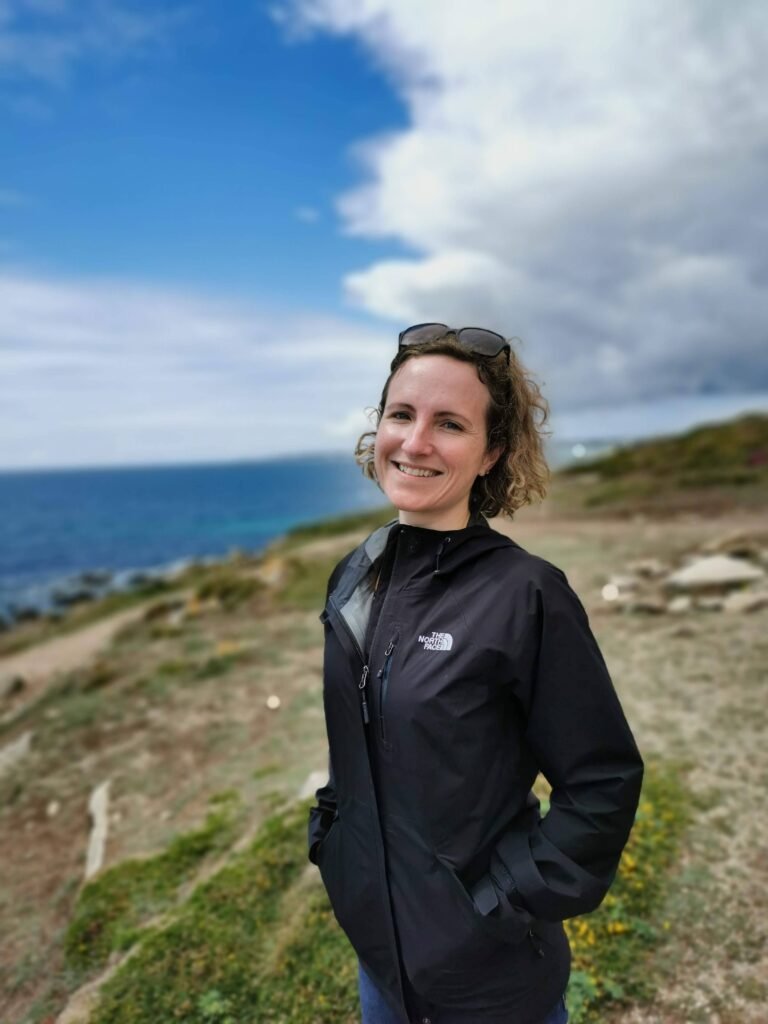
Dr. Morgann Perrot is a Faculty Lecturer at McGill University who studies how the Earth’s crust deforms, breaks, and builds mountains, with a special love for the Northern Appalachians. She combines fieldwork with isotope geochemistry to piece together the tectonic history hidden in rocks. As a dedicated educator, she brings her research and field experience directly into the classroom, teaching field mapping and structural geology related courses.