
From getting stranded in the middle of the desert and walking two days to the nearest town, to burning the soles of his shoes on two-week old lava, Chris Spencer is truly a well-travelled geologist and adventurer! As a professor at Queens University (the best job in the world according to Chris), he teaches field geology, helps run the geochemical facility, and does research all over the world on tectonochemistry. Listen in to hear his advice for students, fun travel stories, and passion for the earth that shows in every story he tells.
Listen now:
You can also listen to our podcast on these platforms:
Read along with the podcast transcript:
Introduction
Hello, everyone. Welcome to Beneath Your Feet, a geoscience podcast. I’m Veronica Klassen, science communicator, geology enthusiast and your host. Here at the APGO Education Foundation, our mission is to spark curiosity and passion for the geology of Ontario. Whether you’re a geology nerd, science enthusiast, or nature lover, this podcast is for you. Join us as we geek out over fascinating geology, uncover the hidden stories
and secrets of our extraordinary planet and explore the captivating world beneath your feet.
Veronica Klassen
Hello, everyone, and welcome to another episode of Beneath Your Feet. Today, our guest is Chris Spencer, who is a researcher at the University of Queen’s in Kingston, Ontario. He studies tectonochemistry, which is something that I am not familiar with so I’m very excited to learn more; with a lot of research rooted in fieldwork, including lots of travel, which I’m also very excited to hear about. So thank you so much for being with me here today.
Chris Spencer
Happy to be here.
Veronica
All right. So to get started, just tell us a bit about yourself. Who are you and what do you do?
Chris
My name is Chris Spencer. I am a professor of geology at Queen’s University. I’m originally from the US, but left the US about 15 years ago and did my Ph.D. and post-doc in the United Kingdom. And then I had a research position at Curtin University in Western Australia and since 2020 I have been a professor at Queen’s.
Veronica
And what is a day in the life look like for you?
Christ
Yeah. So I mean, as a professor, I think the most natural thing that I’m doing is teaching students. And so my role in the teaching program at Queen’s is primarily focused in teaching field geology. And so I teach a few different field geology courses to our students at Queen’s, just teaching them how to do things in the field, how to be a field geologist, how to read and interpret maps, how to construct maps, and how to extract information from rocks that become spatially relevant, and then how to collect samples that we can take back to the laboratory to do other tests to, I guess, evaluate the properties of those rocks.
So teaching is I guess kind of my my first duty as a professor. But then I also run the geochemical facility at Queen’s with a colleague of mine. And the geochemical facility is where we have lots of different instrumentation that is used specifically to evaluate the composition of various rocks. But in addition to analyzing rocks, we also analyze a lot of biological specimens that have geologic interest. And then we’re able to then use the compositional features of various samples to understand kind of how they formed and how they have evolved through time. And so I do spend a lot of time in the laboratory working with technicians and students for the isotope facility at Queen’s.
And then the third part of my job is doing fieldwork for my own research and for the research of my graduate students. I’ve got about a dozen students that are working with me, ranging from undergraduate students all the way through to master’s and PhD students. And their research is happening all over the world. I’ve got a student who’s on a plane right now to China to do some work in China, and then I’ve got students who are working in West Africa, students who are working in Europe and South America.
And so I tend to travel around a lot specifically to look at the rocks in different localities and to collect samples and then bring those samples back to my laboratory to see if I can understand better kind of when they form to how they formed and how they fit into a larger system of kind of planetary evolution, how the planet has changed over time.
Veronica
That’s so interesting. And can you explain a little bit like what actually is tectonochemistry?
Chris
Yeah, So tectonochemistry is a silly word that I that I made up to describe the research that I do because I am very interested, as I said, in the evolution of our planet and specifically the tectonic evolution. So plate tectonics is kind of what is a dominant feature that’s happening on the surface of the earth, where we have tectonic plates that are kind of floating around on the mantle.
And the interactions at plate boundaries are what leads to things like volcanoes and metamorphism and earthquakes. And today we have kind of a very clear understanding of those tectonic processes. However, it is unclear how those tectonic processes have evolved over time. We think that the Earth’s mantle today is much cooler than it was billions of years ago. And so you can imagine in the same way as if you’re cooking a pot of oatmeal, if you turn the stove very high, that oatmeal is going to cook differently than if you have the stove on very low. And so my research is trying to understand how plate tectonics have evolved over time as the Earth is slowly cooling.
And this also has implications for other planetary bodies like Venus and Mars, where Venus has a surface that is much hotter than Earth, and Mars has a surface that is much colder than Earth. And we think that has to do specifically with what’s happening in the interior of these planets, that Venus being hotter, Mars being colder, and Earth being somewhere in the middle.
And so then the chemistry aspect comes into play because that is the dominant tool that I use to evaluate the evolution of plate tectonics through time. And so using elemental chemistry and isotopic chemistry from rocks of different ages, spanning from minerals that are 4.4 billion years old, meteorites that are 4.5 billion years old, all the way through to rocks that are that are forming today in modern volcanic systems.
And so tectonic chemistry is simply the pursuit of understanding tectonic processes and the evolution thereof using geochemical data.
Veronica
Okay. Interesting. So what you’re saying is you’re using chemistry in order to understand plate tectonics and specifically how plate tectonics have changed over time. Is that correct?
Chris
Yeah, that’s right.
Veronica
That’s super cool. That’s awesome. So that is part of your job, you do a lot of traveling for your job as well. So could you tell us a little bit more about what that is like for you and what is the most geologically interesting place that you’ve traveled to?
Chris
Yeah, so there was a geologist from over 100 years ago that said the best geologists are those who have seen the most rocks. And although I’m not entirely sure that is true, I definitely think I seeing more rocks, it provides me with a broader perspective on the types of processes that are active today, but also that have been active in the past.
And so I’ve really tried to make it a point to see as many rocks in as many different localities and different settings as I can. And so there are definitely geologists who have traveled more than I have. For example, I’ve never been to Antarctica. But I’ve traveled around to over 40 countries looking at rocks that, again, as I said, range in age from billions of years old through to the present.
And picking what the most geologically interesting place I’ve traveled to is like choosing which of my children is my favorite. It depends on the day because sometimes one is definitely more favorite than the other. But the places that I’ve traveled to have been interesting in and of their own right that there’s lots of interesting things to be seen no matter where you go, whether it is high in the mountains where we have active tectonics or whether it is in glaciated areas where there hasn’t been active tectonicism for 3 billion years, but instead of looking at the new mountains, now we’re looking at very old mountains and we’re looking at kind of the guts of ancient mountains.
But if you really twisted my arm and you forced me to tell you which is the most geological, interesting place I’ve traveled to, I would probably have to say New Zealand. And the reason why I would say New Zealand is because New Zealand has such a beautiful diversity of geological processes that are happening today.
On the North Island, you have some beautiful modern volcanoes that are erupting, that have been erupting within our lifetimes and are still considered active volcanoes. You also have ancient volcanoes that are tens of millions of years old that help us understand kind of what the volcanoes look like today and then how they have been modified over time through erosion and other weathering processes.
But then when you go to the South Island, you start seeing a very different style of geology where you have the southern Alps, a very high mountain range. In fact, it’s one of the only places on the planet that I’m aware of where you have active glaciation in a near subtropical zone. And so it’s amazing that I can stand at the bottom of the mountains in a fern forest, a rainforest, and then I can look up through the trees and I can see active glaciers. Whereas other places where I have been working, where we have active glaciation, are usually in places where you don’t have rainforests at the foot of those tall mountains.
And and then also in the South Island, we’re able to see kind of the guts of ancient volcanoes that are about 100 million years old. And so it gives us a perspective to view active tectonism, active volcanism, but also then digging back deeper in time to see what’s happening deep in the in the Earth’s crust.
Veronica
That’s so awesome. New Zealand is so gorgeous. So surely you probably have some great travel stories from all of the travel that you do. I’m very curious what is the most bizarre or dangerous or chaotic thing that’s ever happened to you while traveling or doing research for the sake of geology?
Chris
These types of stories are always a little bit embarrassing because the maybe the most dangerous or chaotic things that I have done are things that I probably shouldn’t have done. And so it’s me kind of making confessions of of my negligence.
I was in southern Italy on the volcano of Etna in Sicily. And we were-this was within about two weeks of the last eruption. And we were hoping, obviously, to see an active eruption. But we’d arrived just too late. But a friend of mine and I were kind of exploring some of the recent lava flows. And as we were walking around, we kind of noticed that there was a lot of steam coming up from the ground. And the steam usually also comes with a very strong sulfur smell. And that’s not unusual for recent lava flows.
But then I started realizing that my feet were feeling really heavy and I couldn’t figure out what was what was happening. And and I started getting a whiff in addition to the smell of rotten eggs that was coming from the volcanic gases, I also started smelling burning rubber.
And I kind of looked down at my at my boots and I could see that my boots were starting to melt. And right at this moment, one of our Italian colleagues started shouting for us to get off of those floes, get away from that area, because we unknowingly had had started walking across the flows that were only about two weeks old and they were still hot enough that that it was melting my boots. And so we very quickly got off of those rocks and got to safety. But that was a little bit interesting.
I also had a time where and again, when you’re doing fieldwork, you should never be doing fieldwork alone. But I was a little bit less risk averse than I am now when I was a PhD student, and I was in southern Namibia and I was in an area that there wasn’t active diamond mining where I was, but I was in an area that was referred to as the forbidden zone or the Sperrgebiet.
And this was a buffer that prevented people from trying to cross the desert to the diamond mining areas and then kind of smuggle diamonds out. And so this was kind of a protective buffer.
And I had a permit to be there and no problems as far as the government was concerned. But unfortunately, I got my truck stuck in the sand dunes and again, being alone, I just had to kind of work at it to get my truck out of the sand dunes.
And I worked for two full days trying to get my truck out of the sand dunes and I couldn’t do it. And I had a satellite phone, and so I knew that if I was in real danger, then I could call in the calvary and I would be fine. And so after two days digging through the sand, trying to get my truck out of the sand, I decided that I was going to walk to the nearest mining town.
Veronica
Wow.
Chris
And so it took me it took me two and a half days to walk through the desert until I got to this mining town. And and I just filled my backpack with the food and water that I needed. And then I just slept in the dunes. And then eventually got to the mining town, and I was greeted with armed guards and they were very confused. And what are you doing here? And I showed them my papers and I said, “Oh, my buggy got stuck in the dunes.” And they said, “Okay, well, let’s let’s jump in and we’ll we’ll go help you pull it out.” And I said, “Well, no, it’s really far in the dunes.” And I showed them on a map where it was, and they said, “Oh, we can’t go there right now. We’ll have to go there in the morning.”
And so they took me back to their little mining camp and allowed me to shower and gave me a nice meal. And then we got in a big dune buggy and we drove out to the dunes the next morning and drove for several hours to get out there. And then they pulled me out of the dunes.
They filled my buggy with diesel and then they sent me on my way and they said, “Please don’t get stuck again. We don’t want to see you again.” And I said, “Yeah, no problem. I won’t get stuck. I’ll get I’ll be more careful.”
So yeah, I guess those will also be two things that were a little bit chaotic. Yeah, but yeah, very exciting.
Veronica
Definitely harrowing. I think people kind of have this idea that, like, there’s not anything left to explore maybe, or that geology can be, sometimes people think that geology is boring, but I think this is a proof definitely that it is not. And there’s always there’s always more to explore and everyone has such a unique experience, which I love.
So you’ve ended up here now getting to travel for a living, getting to teach, getting to do research. But how did you get where you are? I’m curious what your journey looks like. What were some of the highs and lows of your career journey?
Chris
Sure. So my mother would always tell people that I was born a geologist. Because my first day of kindergarten, she she had a little book that it was: What’s your favorite color? What’s your favorite food? What do you want to be when you grow up? And my first day of Kindy, I said I wanted to be a geologist. And from the time I was a small boy, I always loved maps. I loved cross-sections. I really didn’t have a rock collection per se, but I really liked understanding the natural world. And so I’ve always kind of been pursuing some type of career in Earth sciences. I thought that originally I wanted to be a petroleum geologist to go and work in a petroleum industry.
But I learned very quickly that I didn’t want to spend most of my time in an office. And and so I started looking for jobs that would allow me to spend my time outside. And little by little, I kept kind of getting pushed towards more and more study to do first a master’s degree and then eventually to a Ph.D. And and it became pretty clear that being a professor was was what I wanted to do.
And I think the highs of kind of my journey is due to the amazing mentors that I’ve had. I’ve had opportunities to really do a lot of unusual things. For my master’s degree, I lived in the Himalaya for almost six months and then during my Ph.D., my supervisors were both kind of elder statesmen and so they didn’t come out in the field with me, they just kind of sent me out alone. And and they gave me the opportunity to do lots of interesting things and go to lots of interesting places during my Ph.D.. And because we didn’t have to pay for my supervisor and me, it means that we didn’t spend very much of the budget. And so it allowed me to do a lot more because it was just me that was traveling.
Veronica
Yeah. Right.
Chris
And then some of the some of the lows is just I think things that everybody faces is the difficulties of finding a permanent job. I would always tell my students that I have the best job in the world, and therefore, if you want to pursue a job like mine, you have to prepare yourself for competition. And I think that for me, I started looking for permanent jobs as a professor what, in 2014 and it took me from 2014 until 2022 to find a job. So it was six years of of working really hard and applying to dozens and dozens and dozens of jobs until the point when I was actually able to get one.
I think that something that is oftentimes difficult for people pursuing academic studies is getting rejected from publications. And so you submit a manuscript to a journal and you’ve really put your heart and soul into that manuscript. And then the reviews come back and they’re not very favorable. And the editor recommends or suggests rejection of the manuscript. And that’s always very difficult.
But what I’ve learned over time is that the rejections that we receive are things that are meant to improve the science, and it’s meant to improve us as scientists. And so although it is kind of a natural part of the scientific process and it is always considered a low in our journey, I think that those processes are always meant to improve the science and improve us as scientists.
Veronica
Yeah, that’s so true. And so hard when you’re in that when you’re in that moment, when you’re like, I have put so much of my time and energy and work into this paper for it to not get accepted or like you said, when you’re looking for a job and getting rejections from jobs, not getting the job. Yeah, what would you say is something that you like hold on to when you’re in those low moments? Like what kind of brings you through that? How did you how did you keep at it when you had six years of applying for jobs?
Chris
Well, I think part of it was I had two children and so there was a necessity for me to provide for my family. And so that that definitely provided the gumption to just keep going and to say, okay, well, it didn’t work with this one, so I’ll try again with the next one. And so I think having good motivation is always very helpful.
But I think also just an unassailable passion. And I knew this is what I wanted to do and I really, really loved what I was doing, despite the fact that my papers would get rejected or I wouldn’t get selected for a position. I really did love the work that I was doing. And and so I think that that passion and that motivation definitely helped push me through.
Veronica
Yeah. Yeah. And what would you say to students who are maybe in a similar position or they’re just trying to figure out what it is that they actually want to study or do for a career? What’s kind of the best piece of advice that you go to?
Chris
Well, I guess the advice that I give to students has actually changed quite a bit over the past several years. And I used to be very, very firm on chase your passions. Chase those things that you love. And although that was definitely a motivation for me, as I mentioned, I think it’s also really important for us to ask ourselves, how do we want to contribute? What part do we want to play in helping society be better and making the world a better place?
And a lot of my students will say, “Well, I really love the idea of being part of the green energy transition,” and a lot of them find a lot of value in the mining industry and being able to extract useful minerals in a way that is not harmful to the planet but is sustainable and not only provides us with a really important resource and really helps build the economy, but also contributes to the development of the technologies that really make life easier and better and really can provide kind of an upliftment for humanity.
And so I think in addition to chasing one’s passions, I think it’s also really important to ask yourself, how do you want to contribute to society?
Veronica
Yeah, that’s so true. And I think sometimes geology and mining in particular gets a bad reputation for being harmful, and of course there are ways to mine that are very harmful for the environment. But I think there is definitely a huge movement towards using geology and using earth science to help preserve the planet.
Chris
I think that the reputation of the mining industry or the petroleum industry of being more detrimental than it is good is perhaps justified because there have been incidents in the past where mining companies were clearly thinking more about profits than they were about sustainability and and environmental impact. But I think as the world as a whole has improved, as standards, as standards of living has improved, as education has improved, I think that the populace is now to a point where they are demanding greater responsibility from the way that we extract resources.
And what I’m finding with my students that go into the mining industry, that companies are really focusing on ensuring that it’s not just about maximize profit, but it really is about sustainability and about making sure that the mining operations are done in the public interest beyond just how it is benefiting the stock price. And I’m really seeing a pretty dramatic change from when I started my undergraduate degree. There were very different sentiments about resource extraction, both from a public perception but also from a corporate perspective. And I’m seeing that change and I’m seeing that students that are going into the mining industry now really are environmentally conscious and they are interested in not just resource extraction for the sake of resource extraction, but also doing it in a way that elevates our stewardship, elevates our responsibility as earth scientists to ensure that it’s not just about benefiting the shareholders today, but it’s also about benefiting generations of humanity for many, many years to come.
Veronica
Yes. Yeah, exactly. And with just like the perception of geoscience in society, what would you say is kind of the most surprising thing that you found about being in geoscience that you don’t think people know about?
Chris
I think that the public perception of geology specifically is that we are kind of viewed as knuckle dragging Neanderthals and we just like to hit rocks with big hammers and we like to go on big long hikes in the mountains. And while that is true, there is nothing more satisfying than swinging a big sledge hammer and cracking open a big rock, I do really love breaking rocks with hammers.
But geoscience really does go far beyond just looking at rocks. And I think that’s one of the things that I love about helping with this geochemical facility is that geology is about the study of the earth. It’s not just about the study of rocks or the study of minerals. Those things are very important aspects of geology, but in my lab we will we will use geochemistry to analyze bird feathers, to analyze fish scales. In fact, there was even one time we got a cooler full of polar bear feces, we would use isotope geochemistry to understand the migration patterns of polar bears.
And to me all of that fits into that umbrella of geology and geoscience that it really is about understanding, not just understanding the earth, but also understanding the interactions of the systems within the earth. And we often talk about Earth in terms of Earth Systems Science rather than simply Earth Science or Geoscience, because it really is the frontier of geosciences is understanding the interaction between these different spheres, understanding the evolution of the biosphere and its impact on the atmosphere, and then the impact of the biosphere and the atmosphere on the lithosphere and really understanding the interactions both from a top down perspective, so: atmosphere, biosphere, lithosphere into the interior of the earth; but also from the bottom up, how the core is influencing the mantle, and how the mantle is influencing the crust, and the crust is then influencing the evolution and development of the biosphere and the atmosphere. And I really do think that the the frontier of our field is understanding the interactions of Earth’s systems.
And and I think that that flies in the face of a lot of people’s assumptions of what geology is and what geologists are doing today to try and push the boundaries of our understanding.
Veronica
Yeah, that’s so awesome and so true. I talked in another podcast episode about geodiversity and how geology is made up of different parts. And it’s not just one thing, but kind of the goal of geodiversity is to say like geology and environmental science and biology and chemistry and physics, like they’re all so related and we can’t have one without the other. Thank you for pointing that out.
Chris
Yeah I agree.
Veronica
Awesome. Okay, so to end, I will unfortunately make you choose your favorite child again. And what is your favorite geologic feature? I’m going to specify maybe in Canada, if that’s okay?
Chris
Sure. Well, my favorite geologic feature, there are some in Canada, but they are also found elsewhere in the world. And my favorite geologic feature is an ophiolite. And this is very esoteric, but an ophiolite is a fragment of the oceanic crust that has been thrust on top of the continent. And so there’s a beautiful example of an ophiolite in the Bay of Islands in Newfoundland. And this ophiolite is over 400 million years old, and it used to be on the ocean floor. But due to some very specific tectonic circumstances, that ocean floor has been carried up and then placed on top of the continent.
And I think the reason why I love ophiolites so much is because they really tell a story of how dramatically earth’s tectonics can change the environment, how they can change the rock record, and how you can take something that you can imagine today, the ocean floor is very deep, it’s several kilometers underneath the ocean, and that is then being carried up on top of the continents. And I find that the tectonic processes that are responsible for the emplacement of ophiolites to be fascinating and I love visiting ophiolites around the world.
Veronica
So that’s so interesting and a unique answer. Thank you so much for being with me today. Thank you for talking about all of your chaotic and fun travels and for giving some really good advice for students. Yeah, I’m sure our listeners got a lot of out of it, and so did I. So thank you.
Chris
My pleasure.
Outro
Thank you for tuning in to this episode of Beneath Your Feet, a geoscience podcast. I’m Veronica Klassen, science communicator and geology enthusiast. As a reminder, please note that the opinions and views expressed by our guests are their own and do not necessarily reflect the official policy or position of the APGO Education Foundation. If you want to learn more, visit us at GeoscienceINFO.com, where you can find our GeoHikes, podcast transcripts, and additional resources. You can also follow us on Instagram, Facebook and TikTok at GeoscienceINFO or on LinkedIn and Facebook at the APGO Education Foundation. Stay curious and keep exploring the incredible world Beneath Your Feet.
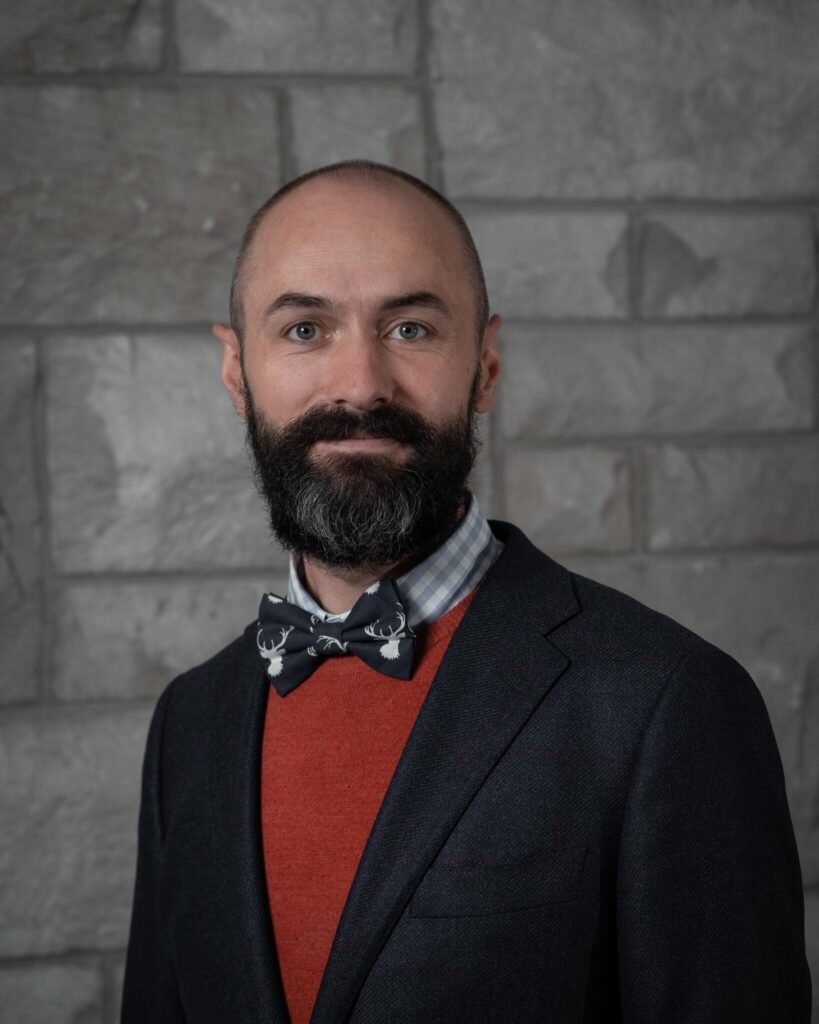
My research broadly seeks to understand the formation, destruction, and secular evolution of the continental crust. Specifically, I am a tectonochemist with research that is rooted in fieldwork and utilises igneous petrology, geochemistry, and geochronology to understand orogenic processes and secular change. My current focus is using stable and radiogenic isotopes coupled to igneous geochemistry as a tracer for modern tectonic processes along with tracking the oxidation of the atmosphere and its reflection in the geologic record.