
Listen now:
You can also listen to our podcast on these platforms:
Read along with the podcast transcript:
Introduction
Hello, everyone. Welcome to Beneath Your Feet, a geoscience podcast. I’m Veronica Klassen, science communicator, geology enthusiast and your host. Here at the APGO Education Foundation, our mission is to spark curiosity and passion for the geology of Ontario. Whether you’re a geology nerd, science enthusiast, or nature lover, this podcast is for you. Join us as we geek out over fascinating geology, uncover the hidden stories
and secrets of our extraordinary planet and explore the captivating world beneath your feet.
Veronica Klassen
Hello, everyone, and welcome to another episode of Beneath Your Feet. Today, I’m going to be talking to Joana Rodrigues, who is a geologist and geological heritage expert working for UNESCO for more than 16 years. She works on geoconservation, science communication, geotourism and local development, based on her experience as a teacher, which is pretty cool.
So thank you so much for being with me today.
Joana Rodrigues
It’s a pleasure, Veronica. Thanks for your kind invitation.
Veronica
Of course. To start, let’s just get to know you a little bit better. So tell us a bit about yourself. Who are you and what do you do?
Joana
Well, as you say, I’m a geologist. In the beginning, I have a background in education. I was a teacher in high school. I teach not only geology, but natural sciences and it was very interesting because I could engage with students from ten years old until 18. So middle school until university, it was very interesting.
But for me, it was cutting a bit my movements and there is not much flexibility in the curriculum. So I felt a little bit stuck in the middle of so much content they need to study for the exams. And so in the meanwhile, I discovered the geological heritage and that really was a game changer because I introduced myself in a new area. I discovered something that was also being discovered worldwide. So in 2005, when I started to study geoheritage, as a research field it was still very small, very few people working. So I had to grow and develop my career also in parallel to the development of the field. So it was very exciting with many milestones and interesting fields.
And after I started with geoheritage, I had the opportunity to start working in a geopark, UNESCO Global Geopark, and that I started combining a little bit of the educational parts and I had to engage with students. But after very few time I started to engage with larger audiences. I started to talk with the policymakers, with politicians, with the inhabitants of the territory, people from national agencies that don’t know geoparks, don’t know geoscience, all kinds of different visitors that tourists that come visit the geopark.
So I started to talk. My day was talking to different people about geoscience, geodiversity, geoparks, and I think it was there that time that my passion about geoscience communication appeared slowly.
Veronica
Yeah, for sure. That’s awesome. And where are you coming from today? Where do you work?
Joana
Well, now I’m just coming from two years at the University. The University of Minho in the UNESCO Chair on Geodiversity and Geoconservation. While I was making my PhD research. I just submitted one month ago, the thesis.
Veronica
Yeah, congrats.
Joana
And these two years I was completely focused on my research. And now I just two weeks ago came back to my former work in the Naturtejo Global Geopark that is the district of Castelo Branco. That is the district that is very close to Spain, to the border with Spain, and almost in the center of Portugal. I’m in the middle of Portugal. So I’m again in the front line of the geopark.
Veronica
That’s so awesome. I’ve never been to Portugal, but it seems like a beautiful place.
Joana
Yeah, you have to come. Not only because of the geodiversity, but also because of all the landscapes, traditions. It’s a country where you can really see lots of monuments and still local traditions and people that really love to show their roots.
Veronica
Yeah, that’s so, so awesome. And just before we keep going, just so that everyone’s on the same page, do you want to just define what geoheritage and geodiversity are? Just in case people haven’t heard those terms before.
Joana
Yeah, indeed, that is one of the challenges I have to work with every day is, what is geodiversity? Because if you talk about biodiversity, everybody knows because for more than 30 years that this word entered in our lives. But if we think about biodiversity, we are just talking about a little part of nature. Usually we use it as a synonym, but in fact nature has, of course, the living part, and the non-living part, the biotic part. Where does the plant put its roots or where do we put our feet? It’s a non biotic part. And that is geodiversity. It’s the elements and the process, non-living ones, that build our planet. The rocks, the fossils, the soil that is the skin. It’s the interface between the biodiversity, geodiversity. Also the processes, the earthquakes, the the processes that make the volcanoes. So all that part that is part of nature, but it’s not live, that is geodiversity.
And inside geodiversity, there are some places that are really amazing. Perhaps if we see the Grand Canyon, it’s more than amazing. So why is the Grand Canyon more than amazing? First, because it’s beautiful. So we look at it and we say, “Wow, it’s like the Eiffel Tower.” It’s a monument. And also because of its scientific value. It’s a place. It’s a special place where we can see the most spectacular process of geodiversity. And also, it tells a long story, long process behind scientific interest. So that geoheritage is those special places of geodiversity where we can see the history of our planet.
Veronica
That’s so cool. Yeah. Thank you so much for defining that. That’s really helpful because yeah, biodiversity is so commonly used, but geodiversity is not.
Joana
People don’t know what geodiversity is because usually it’s invisible, it’s under our feet. We also don’t take care of it. So many times the policies on nature conservation, they just go to the biodiversity. But if we don’t take care of what is under that, how can we protect that biodiversity? So the ecosystem, it’s all integrated system and we have to look to both places.
And that’s why it’s so important that we talk about geodiversity, that everybody understands that there’s, there’s two parts. Of course, some places of biodiversity are much more vulnerable and we have to focus on that. But if we lose the geodiversity, we lose the place to live.
Veronica
Exactly. Yeah. That’s so important. So tell me a bit more about what a day in the life looks like for you. So what are you doing right now? You’ve just finished your Ph.D. and you’re back at the geopark, correct?
Joana
Yeah, correct. It’s usually each day is a day completely different. What I did yesterday is not what I am going to do today or tomorrow. That’s good. That’s a very good part of my job. I always do different things and I have to balance on one side the research part, but also preparing projects, following the projects and then implement. Go to the field, take groups or go with artists or go to the local communities to engage them with the protection of their of their place.
I work in several different teams, international teams, preparing resources to to bring geodiversity to the eyes of everybody. So I usually have lots of meetings and networking. Sometimes it’s a bit boring, but I always think we need this networking. We need everybody working on the same page to take more the geodiversity to the center of the eyes of everybody.
Veronica
Hmm. Yeah, that’s so awesome and such valuable work. I’d love to hear a little bit more about your PhD thesis as well. What were you studying?
Joana
Well, as I told you, I was a teacher. My background was in geoscience education. I had that experience. Then I started, I studied geoheritage, and then I went to the geopark without any preparation for community engagement or participation. And after many years of doing it, I said, No, I have to stop. I put so much effort into this work. I do so many different things, so many different strategies, but I don’t know if what I’m doing has any impact. If all this effort I put in all the strategies, how do I know if I’m doing correctly? It’s because I like? That cannot be a way of measuring. So I decided perhaps now I should go slow a little bit and go back to university and start to to research a little bit on it.
That’s why I decided to focus on science communication, because I thought communication is the channel to bring geodiversity in geoscience to the public sphere. And of course geoparks first because I was working in a geopark already, I had experience with geoparks and other UNESCO’s designated sites and I thought perhaps this place places nowadays if we think globally the geoparks are the institutions that are more focused to work on the public engagement with geodiversity.
So it’s the perfect laboratory. And that’s why I started to study first, the geoscientists that are involved in the geopark project: What are their profile? What do they like to communicate? How do they communicate? Do they have training? So I surveyed the geoscience community. It was very, very interesting.
And then I went to the geoparks themselves and see there’s so many impressive projects, so many amazing resources, museums. So I went to learn. I made some benchmarking internationally and then I came back to the office. I tried to combine everything and I proposed a framework to contribute, to improve a little bit of communication. Because science, communication is a social science also. And social science, they don’t have easy answers. So I can point some solutions. That’s what I did.
Veronica
That’s so awesome. So where did you all go? Like, did you go to all the to geoparks or where?
Joana
That’s important. That’s impossible. There’s more than 200 in the world. So I thought perhaps to focus a little bit more I would go to contexts that would be more similar with the one I’m working with, because if we think the way the culture influences largely the kind of communications. Going to other continents would already be very difficult. So I thought to focus on Europe. So I studied four geoparks here in Portugal, not mine because of course I would not be very neutral analyzing it. So I studied other four geoparks. I studied a geopark in Germany, another in the UK, another in Spain, and another one in the Netherlands to see different approaches and it was really, really interesting.
Veronica
Yeah, that’s so cool. So what were some of your findings as far as like what was working or what was not working for the geoparks?
Joana
Well, my first conclusion is indeed communication, it’s one of the biggest objectives of each geopark. If we think about more than 200 criteria that UNESCO has to designate a geopark, more than half are related with communication. As it is, communicate with students, or with the local communities, or communicate with other geoparks. Communication is really, really important. Raising awareness for climate change, hazards. It is very focused on communication.
And I saw that each geopark, with the same guidelines, they go for very different paths. Of course they are very rooted on their local necessities. If it’s a place with volcanic risk, of course they have to answer to the needs of that community. So I found amazing museums, panels, educational programs, engaging activities, and the diversity and quantity was something impressive.
The things that still have a lots of room for improvement, let’s say. Is on one side, the strategic approach. So geoparks have small teams. Usually they don’t have a communication officer so they have to answer to lots of different things. And the people usually the geologists, biologists that do this kind of work and they don’t have a background in communication.
So most of the things we put a lot of effort and they are not strategic. So I do something here, then I do something there. There’s no connection. If I would have thought before strategically I could have gone through here to then arrive here. But if I start here, then I come here, then I move here. There’s not the strategic and coherent approach to communication, and sometimes we make double efforts or we miss some points. That is one of the main critiques.
Another finding is that we still use, I think because it’s also a little bit lack of, of training, we use strategies that we feel comfortable. So what’s the main one? Panels. Because I made the panel and I put in the geoscience and it’s done. Or I go for a lecture. But nowadays our society goes very, very fast, we all have access to our information in our hands. So in 20 seconds we know what we want. So science communication cannot be only lecturing or providing information. We need to engage people. And for that we need different approaches. We need to to show people why science is relevant, why should they care? We need to find triggers and to catch the attention. That is the biggest challenge.
Veronica
Yeah, for sure. So yeah, just the small teams not really using necessarily the strategies that they’d like to ideally, and things that we’re comfortable with like didactic teaching methods where you just putting up information and expecting people to kind of absorb it.
So I’m curious, if you don’t mind, we stay on this topic for a little bit more. I’d love to hear more about the actual framework that you created and, yeah, what were your goals with that and what is like the actual framework?
Joana
Well, lack of strategy was one of the main weaknesses I found. I tried to organize some principles, actually 18 principles and the main one, the first one, is to organize the communication in a strategic way. So the framework is divided first in the planning. It’s very important to know you need to know what do you want to achieve? And mainly–and this is sometimes why communication fails–What is your goal? Your goal is to teach people, you want them to pass this content and that content? Or your goal is to make people, for example, aware and to make them change their behaviors? If you really want to change their behaviors, this is a goal. And not just saying, we want them to know more about geodiversity.
So if you are specific in the beginning and clarify what are your purposes, you can then design the whole strategy thinking about this purpose. Okay, if I want to engage people in nature protection, to achieve this goal, I have to propose two, three, four initiatives, the ones you need to go specifically to that goal.
So the first step needs to be planning, having the resources, human, financial, etc. And at the end you have to evaluate because also sometimes what happens is some geoparks have amazing materials, beautiful folders, amazing books and guides, activity is super interesting. And at the end you see that people they always like and I do activities in the geopark for more than sixteen years I never had a person that’s said “I didn’t like” or “it was boring” because people like to go to the field and they like to engage with nature. But at the end, what do they take home? Do you think, next time they see geoscience they are going to be, “So this is the important thing.” So monitoring and evaluating the strategies is important because if you have a good strategy and it has no impact, is it worth to put effort on that? No.
These are the main two points at the beginning and at the end. Plan and prepare, and then at the end, evaluate and adapt. Because it can be the best idea, for example, I saw in another geopark, if in this geopark it doesn’t work it’s not it’s not important. And the most impactful part is the engaging, the real engaging part. So if we want people to change their behaviors, to engage with geodiversity, to be more aware of geoheritage, we need to first bring their attention. We have to show them why it’s relevant. We have to use new technologies, perhaps for my generation, taking a folder about the topic. It’s a good strategy because I like to read folders, but teenagers don’t read folders or people who are 20 or 30 years old, they don’t read folders.
So that is something also that you have to include in your strategy. Who is your target audience? If you want to raise awareness for school kids or to families with more than 50 years old, if you define specifically who are your audiences, you will have more chance to have impact because general public is something that doesn’t exist.
We keep saying this is for the general public, but the general public didn’t exist. The person comes from a city or comes from a mountain area, their mindset is different. So we need a different strategy. So this is the core information you need to make a strategy: engaging, intriguing, make questions to the public–Why do they need to know about science?–make it relevant, and also the impact in their daily life. This is the most important part.
If a person comes from an area, for example, with seismic risk, of course, if the person understands that this is connected with the protection of the event that can happen, it will be much more interesting. Or if I showed that, for example, this fruit I have here is connected with the soil of the region. We need triggers. Emotional triggers are very important and this is something that’s really missing in most of the strategies.
Veronica
Yeah, I really like that. The emotional triggers part, I honestly hadn’t really thought about that because, yeah, you need something that’s bringing you in and something that people actually care about already in order to make them care about something new.
So is this going to be used at geoparks? I know you’re back working, is this framework like–I know, I know you’ve just submitted your thesis, so maybe you don’t know the answer to that question–but is the goal that it would get used at UNESCO geoparks?
Joana
That I really would like. I have presented the writing and frameworks in the geoparks conference and I had very good feedback and I have already published the paper and I had very good feedback. Of course, and it’s not possible and easy to implement the framework it is something ideal. I know already that most of the geoparks will never have a press officer, a multimedia specialist of course. But I think also one of the advantages that I try to introduce in the framework is that it’s flexible. It’s flexible for your own territory, the demands you have there, what kind of topics do you should address more. So I, I think it’s flexible enough so that you can use, you don’t need to use everything, but you can take some parts that make sense for your territory.
I hope that I will have the chance to implement something and also after that, also to understand if it’s useful or not. Because for now I have very good feedback, but I still haven’t had a geopark implement it and have said, okay, it’s worth it or perhaps not.
Veronica
Yeah, exactly. Okay, that’s awesome. So the goal would be to get people using it and then get feedback and maybe improve it or see if it works well. That’s really cool. Okay, awesome. Thank you so much for taking this tangent with me. I really appreciate it. I’ll get back to our questions.
So something that I talk about the podcast a lot is the public perception of geoscience. So for you in your career, what do you find has been the most surprising thing that you think people don’t know about geoscience or geodiversity or geoheritage or any of those things?
Joana
Well, first, I think that the perception of geoscience is not very good. We always think about Sheldon, that geologist, as dirty people. And indeed there’s a geologist works with stones and with oil, and you just want to dig. And actually in my career, with geoconservation, it’s completely opposite. I’m a nature advocator, so it’s completely opposite. And nobody knows that.
And I think what most surprises people is that geoscience is completely and deeply connected with daily life. The food, the water, the energy, the materials. And people, they don’t understand that they have geology everywhere. And it’s not only about rocks, but it’s about understanding why there’s going to be, for example, a flood. Unfortunately, when there’s heavy rains, there’s floods and people are very, of course, they are angry with that. But most of the time if we study geoscience, we should predict that some places it’s normal. There will be floods because the rivers need space, there’s too much water. People don’t see geoscience, they don’t understand the real impact. It’s not only resources. Of course, mines and quarries are very important, but geoscience can give answers to more than that.
And one of my works is really to show what’s the connection between an orange and geology. And people have no idea the climate, the temperature, the quality of the soil is connected with geology and that will improve the wine, the terroir of the wine will improve the taste of the wine because of geology. And that is something that we depend on geology.
And I think that that surprises most of the people after “Oh, at the end geology is everywhere.”
Veronica
Yeah, that’s so true. I feel like people don’t think about necessarily where things come from or the impact of soil and where the soil comes from. Like we don’t really trace things back. And I feel like that’s I feel like that’s a major problem with sustainability in our culture is that we’re just consuming a lot.
Joana
There’s a very interesting exercise you can do. You have a table or a room full of things, and then you ask people, “Give me one thing that is not connected with geodiversity or geoscience.” And okay, you have the iron, you have all the construction materials. Oh, I have here a wood desk. But to have a wood desk, you need some metal materials to cut the wood. Or of course you have some vegetable cotton clothes or most of the things we really need the natural mineral resources. And even if you have an orange that is something that grows in nature, perhaps you needed a stair to go pick the orange. So at the end there’s almost nothing. So the resources are always there, the geological resources.
Veronica
Yeah, I mean, everything comes from the Earth. So really it shouldn’t be too surprising that everything is related.
Joana
But it is. But it is.
Veronica
It is. Yeah, exactly. People don’t necessarily think about it.
Okay, I’m going to transition a little bit to talk more about students. So you started your career in teaching and I know you also do a lot of mentorship for students. To start, do you want to just tell us a little bit more about what you do, about that aspect of your work?
Joana
I think the work I do goes more or less in the same direction, in different levels. And what I try to do on one side with the non-experts, I try to show where is the geoscience and help people to put some glasses, special glasses, where you see geodiversity and not only biodiversity.
And also with the students and geoscientists. I also train a lot of already geologists that work in the field, but I also train UNESCO site managers, and teachers. It’s to give them tools to be more equipped to make the same. Or this means to help people that they have the scientific knowledge and then there are many amazing geologists, amazing experts that do very impressive research or technical parts. And then they have difficulties because not everybody likes to be exposed and talk with non experts. And I try to give them some skills because sometimes they have difficulty understanding what is the relevance of their work to the community, to the societies.
So in my trainings I try to provide these skills that is not only helping to translate because usually there’s these traditional principles. “So you have to translate. You have to avoid jargon and you have to use metaphors.” Of course, this is very important for the speech because you need the common ground if you are talking with people. We understand if I say to you I have problems, I’m going to study a hotspot, you think I’m talking about Internet, but for geoscientists a hotspot is a place inside the Earth. So of course you have to avoid this kind of misunderstanding.
And so in my trainings I try to, on one side that geologists understand their weak points, where we are failing, and then try to give some tools. And the tools usually focus on showing relevance using innovative science based tools. Because science communication has already given many research findings with specific answers that we can use to do our best.
And also then, help them to develop their own strategies. And how do they feel? There’s people that like to write, others like to talk, others like to make practical activities and go to science fairs, others like to make videos for social media. So, everybody needs to find the best way to communicate. And if they don’t feel prepared, and they don’t like, they should not communicate. We should feel comfortable with what we are doing.
Veronica
So you’re really helping people who might not have any experience communicating start to understand the relevance of their work and how they can get it out there and get people to understand what they’re doing.
So what would you say is your best piece of advice that you give students if they’re like trying to figure out where to go or what to do? What’s your main go-to piece of advice?
Joana
Well, first, you need to go after something you like and to feel comfortable, because usually all these paths, they bring you many, many challenges. And one of the first things that I think that is with everything in life, if you do because you really like it, you are more prepared to face the challenges and to explore interdisciplinary paths. And perhaps 40 years ago someone would study geology and would work for a more traditional geology job. Well, this career nowadays, people change and they move from one career to the other. Even if it’s inside geology you can go to law, communications or areas that were not traditional. So I think first you need to like what you really do and be prepared and open mind for challenges. And be curious. Of course, that is in any science you need to be curious. Otherwise you don’t have the trigger to go after your paths.
Veronica
Yeah. Okay. Awesome. Yeah. So be curious and follow something that you enjoy.
Joana
Yeah.
Veronica
Okay. Amazing. So how does your work help people understand the role of geology in their lives? I feel like we’ve kind of talked about that, but do you have anything more you’d want to talk about with that regard?
Joana
Well, I think it’s the most important thing is if you help people so that they themselves can find the connection between the geology and their life, the materials they use. But also the way they do the agriculture, the way the buildings are built, the stones that are used in some cities or some historical places, they are connected with the rocks. So that the local identity, in the mountains, people have a different mindset than people that live in the desert, because the earth challenge is very connected with geology, they impact their lives. So I think this is the easiest way because you will help to solve people’s problems and challenges with specific and concrete things about geology.
Veronica
Hmm. That’s super helpful. And if you could, what would you change about the perception of geoscience in society?
Joana
Well, it’s not a dirty science, right? So I think to that change that perception that geologists just want to dig. Nowadays that our planet is really facing really real severe challenges. It’s important to increase the recognition that geoscience is fundamental also for sustainability. It’s not something just for mining, we have to shift this perception from rocks and fossils to the earth system and how the earth system shapes your life. I think, encourage this more human centered, let’s say, communication perhaps will help people to be a bit more aware and change the perception that geoscience can contribute to solve our environmental problems. And not only cause, as unfortunately in the past geology was very connected with.
Veronica
Mm. Yeah, for sure. Awesome. Okay, well, yeah, Thank you so much for talking with me about all, all of this awesome work that you do. To end I always just ask, what is your favorite geologic feature or rock?
Joana
That’s almost like asking which of your kids do you prefer? It’s not an easy question. Well, I like very much granitic landscapes because I come from a region with amazing granite. But I think in my heart nowadays, I think the volcanic islands are one of my favorite geological places.
Veronica
Which islands are you referring to in particular? Which ones have you been to?
Joana
Some volcanic islands in the Mediterranean. We also in Portugal, we have amazing islands in Spain, in Italy. So there’s very nice paradises with volcanoes and big volcanoes in the islands. That’s my favorite landscapes.
Veronica
Okay, awesome. Thank you so much for talking about geodiversity, geoheritage, and how we can actually start to get people to understand what the role of geology is in their lives. And I’m really excited about this framework that you’ve created. I feel like it’s going to be very helpful for people in your industry, so that’s really cool.
Joana
Well, thank you very much. It was very interesting. And that’s my passion is to talk about my job and about our planet with other people. So thank you very much for your kind invitation.
Veronica
Of course, of course.
Outro
Thank you for tuning in to this episode of Beneath Your Feet, a geoscience podcast. I’m Veronica Klassen, science communicator and geology enthusiast. As a reminder, please note that the opinions and views expressed by our guests are their own and do not necessarily reflect the official policy or position of the APGO Education Foundation. If you want to learn more, visit us at GeoscienceINFO.com, where you can find our GeoHikes, podcast transcripts, and additional resources. You can also follow us on Instagram, Facebook and TikTok at GeoscienceINFO or on LinkedIn and Facebook at the APGO Education Foundation. Stay curious and keep exploring the incredible world Beneath Your Feet.
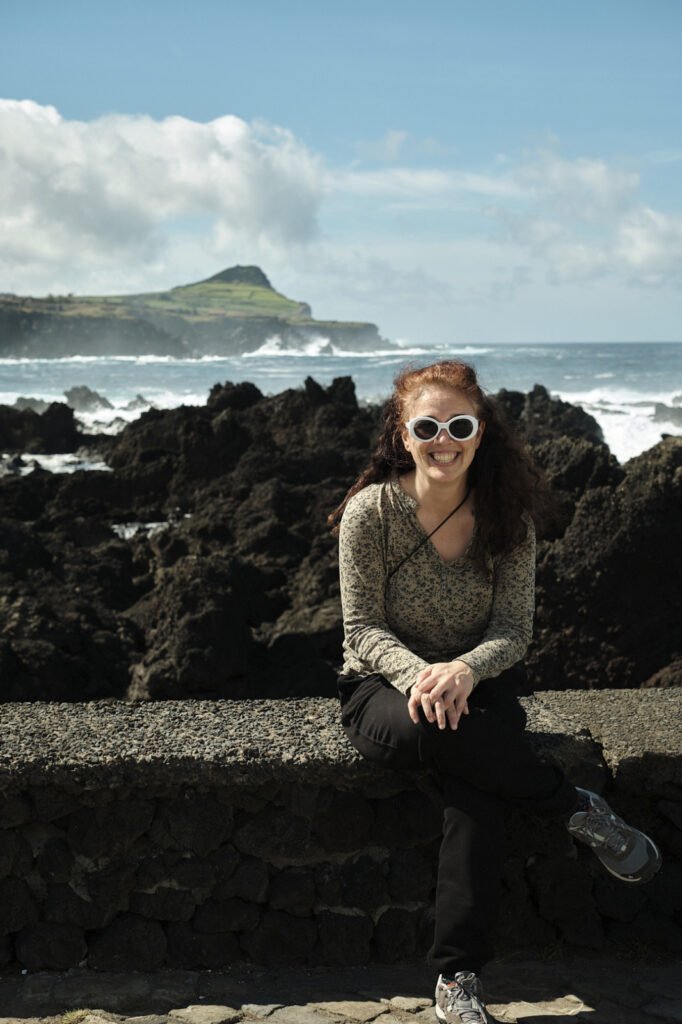
Joana is a geologist with a background in geoscience education and extensive experience in geoconservation, public engagement and UNESCO Global Geoparks. Her work focuses on geological heritage, geotourism, science communication and local development, strengthening connections between people, place and sustainability.
A dedicated advocate for increasing the visibility and protection of geodiversity and geological heritage in policy and implementation, she collaborates with multiple national and international networks and institutions.
She is also an experienced trainer, supporting educators, guides, conservation and heritage managers, and territorial stakeholders in developing their skills.
Joana is also a researcher in geoconservation and science communication, exploring how geodiversity and the geosciences can be made more relevant and inspiring for the public and how geoscientists can communicate their work more effectively within society.