
Join us as we explore an exciting new topic for our podcast — planetary science!
From Martian landscapes to icy plumes on distant moons, Dr. Tanya Harrison explains how cameras help us explore other worlds and what those images reveal about the potential for life beyond Earth.
Listen now:
You can also listen to our podcast on these platforms:
Read along with the podcast transcript:
Introduction
Hello, everyone. Welcome to Beneath Your Feet, a geoscience podcast. I’m Veronica Klassen, science communicator, geology enthusiast and your host. Here at the APGO Education Foundation, our mission is to spark curiosity and passion for the geology of Ontario. Whether you’re a geology nerd, science enthusiast, or nature lover, this podcast is for you. Join us as we geek out over fascinating geology, uncover the hidden stories and secrets of our extraordinary planet and explore the captivating world beneath your feet.
Veronica Klassen
Hello, everyone, and welcome to another episode of Beneath Your Feet, the geoscience podcast where we talk to geologists of all different kinds in order to hear their career stories, advice for students and just fun, exciting things that are going on in geology today. We are branching out to a topic that we haven’t explored yet on the podcast, and that is planetary science.
So today we’re going to be talking to Dr. Tanya Harrison, who is a professional Martian. She is currently a fellow of the Outer Space Institute and the director of Earth and Space Science at the Canadian Space Company, Mission Control, based out of Ottawa. She is a planetary scientist, future focused science strategist, author and one of the world’s go-to voices on Mars and space exploration.
So thank you so much for being with me here today, Tanya.
Dr. Tanya Harrison
Oh, thanks, so much for having me.
Veronica
Let’s just start with a little intro. Tell us about yourself. Who are you and what do you do?
Tanya
Oh, gosh, I don’t know how to follow up the bio.
Veronica
Yeah, true.
Tanya
In terms of what do I do right now, so my background is in planetary science, like you said. I feel like a lot of folks have never heard of that term, if you are not a planetary scientist. So basically a geologist, but studying other planets. And in that process, especially if you’re studying rocky bodies like Mars or the Moon or Mercury, you have to understand geologic processes on the Earth first, because we see all the same stuff when we look at these places.
Veronica
Right.
Tanya
Well, for the most part. We can get into that later. There’s some cool stuff on other planets that we don’t see here.
So yeah, you can take your geology background and then apply that to studying things like impact craters on the moon or volcanoes on Mars, or weird cracks in the surface on Venus. And I think that’s pretty cool.
Veronica
That’s so awesome! Wow. Okay, so what does a day in the life look like for you?
Tanya
So right now I work for a commercial space company called Mission Control as their director of Earth and Space Science. And so some of it is doing science, but more focused on what do we need to do to design instruments and missions to achieve specific science goals. So, if you’re trying to answer certain questions, say, and you need images to answer those questions, you want pictures, you know you want a camera, but what resolution should that camera be?
What wavelengths of light should it be imaging at? And probably most importantly for space, how do you get it into the constraints of mass, power, and cost that you have for your mission, which are usually very, very tough to do. So you come in with these huge dreams about all these things you would want to do as a scientist. You want all the answers, right? But then at the end of the day, you come back with like, you know, one tenth of what you were dreaming you could do because of all the constraints that space and budgets put on you.
Veronica
Yes, oh, my gosh, that’s totally fair. So, yeah, essentially you’re just like, what can we do, what questions can we answer? What can we do with the time and money and space that we have, which I imagine is quite the challenge.
Tanya
Definitely. And then you work with engineers to actually build this. I am not an engineer at all.
Veronica
Right, okay.
Tanya
And the engineers aren’t planetary scientists, so they won’t know without somebody telling them, ‘Hey, we need something that can do this,’ then they can go and build it. And then usually that’s another meeting of the minds in the middle, like, what do the scientists dream of?
And then what do the engineers tell you is possible.
So it’s so it ties really well, I guess, to the idea of science communication in general, because you’re communicating with people of a ton of different backgrounds to try to get a mission to actually happen.
Veronica
Right. What is your specific niche or area of interest within planetary science? I know you’re working on technology like cameras and things like that. Would you say that’s kind of your niche where you find yourself?
Tanya
Yes, like cameras and camera operations, but more on the geology side in particular, my background was in landslides. And really, any way that something can fall down a hill. Because there’s a lot of different ways something can fall down a hill, whether that’s a landslide or a glacier flowing down a slope, because there are what we think are dust covered glaciers on Mars, as well as the remnants of where glaciers used to be and they’ve left some stuff behind that is very indicative of the glaciers having been there in the past.
My fascination from that was because in my very first space job, I worked in mission operations for two cameras on NASA’s Mars Reconnaissance Orbiter. And one of the jobs I was assigned to do with that was to look at these features on Mars called gullies that are these very young landslides that look like they are still active on Mars today.
And this was 20 years ago. So we’d only seen an activity in a couple of them. So my boss, who was the one that had discovered this originally maybe a decade or so before I started to work for him, he was like, ‘your job is to monitor thousands and thousands of these things and see if you notice them changing over time.’
Veronica
Wow.
Tanya
And I discovered like 12 more of them in the span of a few years working there. So I was like, this is the coolest thing ever. So when I left that job to go get a Ph.D., I turned that topic into my PhD thesis.
Veronica
Right. Oh my gosh, that’s so cool. So what was your Ph.D. looking at specifically?
Tanya
Yes, So it was kind of taking a zooming out view in each chapter. So the shape of the gullies tells us that water was probably involved in how they formed because they’re very similar to channels on Earth, on the slopes of mountains, for example, that are carved by water. But they also only occur in specific latitude bands on Mars. And that was telling us something about the climate history of the planet.
So without going too deep into the rabbit hole on that, I mapped out where they were across the whole planet to figure out, okay, what does this tell us about where water or ice was in the last few tens of millions of years on Mars? And what implications does that have for astrobiology? Because if there was water involved in these and it was liquid water, anywhere we find liquid water on Earth, there is something that has managed to survive there. So if we can look for these things on Mars, that’s kind of been NASA’s path for Mars exploration since the early 2000s was this idea of follow the water.
So everybody’s just been chasing down different ways to look at what water was doing on Mars in the past and where it might be today in case there’s some kind of microbial life that’s still hanging out.
Veronica
That’s so cool. So the kind of the overarching question is like, is there life on Mars or was there life on Mars? And then from there we’re like, okay, water is the key to life on Earth. So theoretically, also the key to life on Mars.
Tanya
Exactly
Veronica
Wow. That is so interesting. This is so, so cool. What do you think is kind of one thing that I mean, I’ve already been surprised, but what are some other things that you think would surprise people about a career in planetary science?
Tanya
So many things. I feel like one of the coolest aspects of it is you’re just constantly learning stuff because you’re getting new data to work with. You’re working on new missions, you’re waiting for new missions to come up, and all these other planets and asteroids and moons in the solar system are so weird and wonderful that there’s a lot out there still waiting to be discovered, even though we’ve been taking images and other types of data of these places for decades or in some cases, hundreds of years with telescopes going back to people like Galileo and Copernicus.
Veronica
Yeah.
Tanya
But we get new glimpses all the time. I mean, there’s people that are reprocessing data from the Voyager missions in the seventies today with better imaging processing software and discovering moons that we had never seen before. It’s so cool.
Veronica
That’s amazing. Oh, my gosh. Okay, so speaking of that, like, are there any recent discoveries or things that have kind of changed what we know about Mars?
Tanya
I think the biggest one that folks may have seen in the news relatively recently was these new biomarkers that the Perseverance Rover found. And these are basically very distinctive features in a rock that the rover came across, that on Earth, the only way we know that they form is through some kind of biological activity. Unfortunately, Mars has been very good in the past of teaching us about how things that on Earth tend to only form from life can also form from geologic processes under the weird conditions Mars has. You know, it’s really cold, it’s really dry, wind has been the major source of erosion for three and a half billion years or so. And so that leads to some interesting things that we just don’t see here because we’ve got things like plate tectonics, which Mars doesn’t have. We have rain, we have volcanic eruptions. Mars had those things millions and millions to billions of years ago. But it hasn’t been active in that sense any time recently. And so I think people are really excited because these are the strongest case for something that would have been formed by life in the ancient past, not something that’s alive making these features today.
But I’m cautious because of our past discoveries that have just taught us about more things geology can do. Which is still important, but to the people that are not geologists maybe less exciting than discovering aliens on Mars.
Veronica
Yes, exactly. Do you think it’s like likely or realistic that we would find some sort of evidence of life on Mars?
Tanya
I hope so. I’m not super optimistic that there’s life on Mars today. It’s just a really inhospitable place to life as we know it. But we know that Mars was very Earthlike at the same point in the history of the solar system as when life arose on Earth. And so if you have two planets that are right next to each other in the same solar system with, from what we can tell, pretty much the same conditions. Based on our sample set here of the fact that life is everywhere on Earth that it can possibly survive, it feels like it would be reasonable to find it on Mars.
I’m less optimistic that we would find it with a rover just because–the rovers are extremely capable, they’re amazing pieces of engineering–but they can only dig so deep. You know, they’ve got really tiny drills. They can’t drive very fast, even compared to how far a human could walk in a couple of weeks on Mars. So I think it’s going to take you’re going there and taking drill cores kind of like we do on Earth, where we’re taking ice cores in places like Greenland and Antarctica to understand the climate history and some biological history. And we’ve got microbes and stuff hanging out in those ice sheets.
Veronica
Yeah
Tanya
My dream would be to go take a core of the ice sheets of Mars and pull it up, and you just find all sorts of evidence for life preserved in there. It’s like, there you go. Undeniable evidence. We know that this is from Mars.
Veronica
Right, right. Oh, that would be so cool. Is Mars also unique amongst the planets in our solar system? Like, is there a reason why I feel like Mars is talked about the most or the most, I don’t know, promising? Is that true to say?
Tanya
I think, you know, 15, 20 years ago Mars was kind of the sole focus for, you know, this is the place we’re going to find life beyond Earth in the solar system, because we knew that it had been pretty Earth-like in the past. But now that we have a lot more data about things like some of the icy moons of Jupiter and Saturn, where there are liquid oceans of warm water underneath these caps of ice, that are still being heated today. We’ve detected organic molecules shooting out of geysers of one of the moons of Saturn called Enceladus.
Veronica
Oh cool, I didn’t know that.
Tanya
So we know that the ocean has the building blocks for life in it. As opposed to a place like Mars where the liquid water is for the most part, from what we can tell, is gone. And you know, there’s been some news stories in the last few years about detecting something called phosphine in the atmosphere of Venus, which tends to be biologically produced on Earth. And so there’s been some suggestion that maybe there’s some kind of microbial life in the clouds of Venus. This has been suggested for a while, but the detection of phosphine kind of led to put more credibility to that idea. So I think if we just start to get more creative about thinking about life and how it can survive, it starts to become more clear that if we’re looking for life that is alive in the solar system today, Mars is probably not the best place to be looking like we should be looking at the ocean of Enceladus. We should be looking at the oceans of the other icy moons like Europa, one of the moons of Jupiter. And there is a mission on its way to Europa right now. I think it won’t get there for like five or six more years, but it might give us some more information about that subsurface ocean, which will be really exciting to learn more.
Veronica
That is so exciting. Wow. Okay. I am learning so much. I know nothing about planetary science. So this is all great to me. Um, let’s switch gears just a little bit and talk a bit more about your career. I know that your career has kind of taken a lot of different turns and changes. How do you navigate the uncertainty of not kind of having a set path or knowing what comes next?
And maybe if you could tell us a bit more about just your journey and how you ended up here.
Tanya
Sure. So when I started college, I went into astronomy because I thought planets are in space, so you should be an astronomer. But it wasn’t until near the end of my junior year when I met with the academic advisor that makes sure you’re going to graduate on time. I realized that I should have been a geologist if I wanted to study Mars. Like I knew I wanted to study Mars since I was like 11 years old, when the NASA Pathfinder mission landed. I saw this little rover drive out onto the surface, this tiny Sojourner rover. I was like, I want to work on Mars Rovers. This is the coolest thing I’ve ever seen.
Veronica
That’s awesome.
Tanya
And so my advisor–like at that point, I had planned out my college pathway like, so meticulously, you know, I would plan out all the courses two plus years in advance. I knew I was going to get a Ph.D. in astronomy. I knew the schools I wanted to go to. I was very much a planner.
And then this professor throws a wrench in things and is like, well, if you want to do geology, you could either, you switch and do a geology master’s degree and then do a Ph.D. or you could just continue doing astronomy if you want or stick around for another year of undergrad and get a geology degree on top of the astronomy and physics as like a double major. But I didn’t want to pay the university tuition for another year. I couldn’t really afford to.
Veronica
Yeah, its expensive.
Tanya
So I took a geology class at that point at the university that I was at and it was a class on glaciology because I had also had this longstanding fascination with glaciers and ice. I grew up near the Cascade Mountains. And so, yeah, just like in the shadow of glacier covered volcanoes, I think that that led to that fascination.
Veronica
Yeah.
Tanya
And it was such a cool class. I loved it. So that’s where my, my interest in, like, glaciers and landslides kind of started. I loved how, like, I thought of glaciers as just ice on a hill, but learning that they move like toothpaste, essentially, they move like, it’s called plastic deformation. They like move down a hill and then they like re-accumulate at the top and they’ll flow back down again. They’re not re-accumulating at the top so much anymore, which is a problem, because of climate change.
Veronica
Yeah, it is.
Tanya
But I just thought that was fascinating. Plus you got to go on field trips to actually go to glaciers and hike on them and see them up close.
Veronica
That’s super cool.
Tanya
I always tell students, like, if you like playing outside, become a geologist because you’ll get paid to professionally play outdoors.
Veronica
Yeah, exactly.
Tanya
So, yeah, I ended up applying to both master’s programs in geology and programs in astronomy, hoping that the universe was going to make the decision for me. And then I got into both and I was like, oh now I have to make the decision myself. This is so hard. But I, I knew my heart was in Mars. Like, I’d been doing research as an undergrad in like, stellar spectroscopy. So using light to look at what stars are made of essentially for a particular type of star system. And it was cool, but it wasn’t where my passion was. So I took the geology path and that was definitely the right decision at the end of the day.
And I think that was maybe the introduction to uncertainty and thinking like, well, I’m just I’m going to kind of go with the flow of what the universe throws at me and whatever feels like the right choice, like go in that direction. Because your gut kind of knows when you’re given like a fork in the road, like you might be debating it in your head and it can be a tough decision, but like you’ll feel it somewhere, you’ll know what you actually want to do.
Veronica
Yeah, Yeah. Trust your gut. I feel like that’s very good advice. Speaking of advice, what would you say is kind of your best piece of advice for students who are trying to figure out what to study or pursue for a career?
Tanya
If you’re not sure yet, don’t be afraid to try a bunch of different things because it might take just that one particular class or like one particular professor that sets you off in a direction that changes your life. You know, I feel very lucky that I have known what I wanted to do forever. Like Mars was around age 11, but space started around age five, and I didn’t realize how much of a privilege that was to have that much focus until I got older and started talking to people that became friends who, you know, they were like in their twenties at some point and they’re just like, Yeah, I don’t really know what I want to be when I grow up yet. And then I met other people who, you know, they would say like, Oh, I never cared about space. And I took this astronomy 101 class with the most amazing professor and you know, they grew up and ended up becoming telescope technicians or professors or working at museums.
And so I think we’re so pressured in school to have everything figured out by the time you’re going into college, you should already know exactly what you want to do. And I don’t think most people have it figured out yet. So that’s exactly what college is for. Or even, you know, taking some time off. If you want to take a gap year to just go figure out life and figure out what’s calling to you, I 100% advocate for taking time off where you can because, you know, in the future, no one is going to care if it took you until you’re 23, 24, 25 to finish your undergrad. You can put a lot of pressure on yourself in the moment and feel like you’re falling behind. If you have friends and classmates that are finishing, quote unquote before you. But in the end, it doesn’t matter. Like you can finish at your own pace. The most important thing that’s going to make or break your experience is enjoying why you’re there in the first place.
Veronica
Oh, yeah, that’s so true. And I feel like, yeah, when you’re in university or college or graduating high school, it feels like such a big thing. But then when you kind of get to the other side of it, you’re like, Oh, that like I could have done something different. I could have taken more time. Like, yeah, it’s obviously easier to think in retrospect, but yeah, it’s okay to take your time and figure out what you want to do. So that’s cool.
Tanya
Yeah, I did not. I rushed through everything and it is one of my life regrets. So any time I talk to students now, I’m like, slow down. College is such a unique time in your life. This probably sounds so stereotypical, like, Oh, it’s such a special time, but it really is. Like even if you become a professor, you very quickly go from doing research to becoming an administrator, becoming a manager of students, and you’re not really the one doing the research anymore.
And so like when you’re in school, just getting to learn.
Veronica
Yeah.
Tanya
Like you don’t have that opportunity for very long. And so, like, I wish I’d maybe take it another year in college, maybe taken more time in my Ph.D., because I could have stayed for at least one more year with the funding that I had. But I was so I was like, No, I have to go get a job.
There’s a job opportunity to chase like I want to make a real salary again. I’m so poor.
Veronica
Fair
Tanya
So but now, like I had a mentor tell me like, slow down. And I didn’t listen to him at the time. I was like, Oh, he was right.
Veronica
Yeah. So in your career, you speak a lot about accessibility and representation in STEM. What are some changes you would like to see in your field to make it more inclusive?
Tanya
I think the geosciences in general aren’t very inclusive because, you know, I said you get paid professional to play outside, but it’s very difficult for a lot of people to access the outdoors if you have some kind of physical disability. And part of that is just inherent in nature. We’re never going to be able to make climbing a mountain accessible to everyone easily.
But for something like taking courses or deciding where your study sites are going to be, you can be more intentional about selecting where you’re going. And I think this was really highlighted to me through a group called the International Association for Geoscience Diversity. A little bit of a mouthful The IAGD. They do accessible field courses that they run during the Geological Society of America conferences each fall. I think they might do more now, but the ones that I knew of at least are with that conference.
And I was part of the inaugural cohort that did a trip where they went up through the whole Sea to Sky Highway in British Columbia, and they stopped at a bunch of different sites. And we had people with mobility limitations, we had a couple of blind students, we had people, a few people with learning disabilities. And every site that we stopped at, there were kind of layers of options for you. It’s like, okay, if you have a wheelchair or a cane and you can’t really go sort of off road, there’s this location. If you’re a little bit more mobile and you want to explore a little more, you can go like down this path, you can go look at these things, but you didn’t miss out on the experience of each site just because you couldn’t access, like all of the options that were there.
Veronica
Yeah.
Tanya
And at this point, this would have been 2013, this would have been early in my Ph.D. So I had done courses in my master’s degree a few years earlier where you had to do field work because it’s part of school. But I have Ankylosing Spondylitis, which is a kind of rare joint condition, to put it simply. And so my mobility was quite limited and I couldn’t participate in field trips. So we would go to places and I would have to go as part of the course requirement, but I would just get left in a van on the side of the road for hours while everybody else trekked up a mountain.
Or once I tried to trek like up a little mountain with everybody because I was like, ‘I want to do it.’ And I couldn’t walk back down. So I had to be fireman carried down the hill from one of my classmates. And, you know, on the one hand it’s like, Oh, this is kind of a funny story to tell later and a bonding opportunity, I became friends with those people in that class. But it’s also super awkward. Like maybe you don’t, you’re not comfortable with someone you barely know touching you that way.
Veronica
Yeah, exactly.
Tanya
Yeah, like just thinking more about, okay, all of the outdoors is never going to be completely accessible, but how do we make parts of it more accessible to people that want to explore? And I feel like the IAGD is one of the only groups that’s really thinking about it in this way. And so I’m so happy that they exist and they are still running these courses over a decade later.
And it’s a learning opportunity for the professors as well, because each student was kind of paired up with a professor and I don’t think all of the professors had disabilities. So it’s a learning opportunity on both sides to figure out like, how could we build better curricula? So I’d love to see more groups think about this and not just have geology be for super fit people that are able to climb a mountain in an hour.
Veronica
Yes, so true. And I think even just having a little bit of intentionality and, you know, thinking about it beforehand goes a long way. And I love that you said like learning from each other too, like the profs and and the students learning from each other and, you know, yeah. Trying to be more intentional. Yeah. And I think with that, I think there’s a lot of people who either for like accessibility reasons or otherwise feel like they can’t be a scientist or they can’t participate in science. So is there anything you would want to say to the people who, yeah, maybe doubt their own ability to participate in science?
Tanya
Being a scientist is just being professionally curious. And so if you have questions that you want to answer and you just really like to dive deep into a subject, that’s all it is. Like we need to dispel the myth that just because you’re a scientist or you have a Ph.D., that you’re some kind of super genius, you’re absolutely not. You’re just incredibly stubborn and like really have a niche topic that you like.
But at the end of the day, it’s not all that different from, say, like an auto mechanic that has spent 20 plus years of his life repairing your Volkswagen vehicles like he knows Volkswagen engines inside and out. He can take one look at your car and be like, yep, that’s the thing. Like, I can do that with looking at a picture on Mars, but I don’t know how to change the oil in a car. Like, yeah, I have no practical life skills. I know stuff about Mars rovers and like Martian weather and that’s it. So I think humanizing scientists and letting people recognize, like all you have to do is just really want to answer questions and be kind of nerdy about it. Like, that’s really the only thing you need to be a scientist to be successful.
Veronica
Mm hmm. That’s so true. And with, like, humanizing scientists, what is the role of communication in your work? Because I know you do a lot of science, communication, outreach, things like that. Yeah. What does that look like for you?
Tanya
To me, science communication is really important because a lot of the work that we’re doing tends to be funded by taxpayers. And so I feel like we have an obligation to communicate what we’re doing with that money and also justify like why money should be spent on that in the first place and being able to communicate the why, ‘why is this important?’ ‘why does it matter?’ isn’t just good for the general public. It’s good for convincing politicians that they should fund the grant programs that you’re applying to as a scientist. It helps expand the budgets of government agencies that are working on these things. Like in the U.S., for example, the NASA budget is very tightly tied to how much the general public cares about space. So if it’s not seen as something favorable in the minds of the public, it’s not going to get a big boost to that. It’s a little different in Canada just because our space agency has very different mandates and a much smaller budget but similar sentiment.
And I didn’t really set out to be a science communicator. It kind of happened by accident. I started as a micro-blogger for the Lunar and Planetary Science Conference back in, I think I was starting my master’s degree, so would have been like the mid to late 2000s, like early ish days of Twitter. I didn’t understand how social media worked. I was like, Twitter is just where Kim Kardashian posts selfies. Is that what it’s for?
But the conference was looking for people to–they didn’t have like public wi-fi at the time, but they were like, oh, if we make you a micro-blogger, you’ll get access to a Wi-Fi network so you can tweet about what’s happening at the conference.
Veronica
Yeah.
Tanya
And this was the point when on Twitter you still had a 140 character limit. So it really forced you to think like, ‘how do I make this information as digestible as possible?’ so that you have a single tweet that captures the talk that you just saw or the sentiment of the day or whatever might be happening.
And then that kind of evolved into in grad school, I worked for the Planetary Society as an editor for their main blog writer. And they got a lot of guest blog posts from professors. And the way that the woman, Emily Lakdawalla, told me to approach the job was, ‘Oh, you need to edit these blogs to remove the acadamese from them.’
And so it was practice every single week. Like, okay, this professor is using a ton of jargon. How can I change this so that someone that is, you know, interested in space but probably has no academic background in it, can understand the takeaway points of why this work matters. And I think that that was probably one of the most valuable experiences in my career doing that job.
It might not seem like much. It’s like, ‘Oh yeah, web editor intern for a nonprofit group.’ But it really taught me how to sit there and think about how do you get a point across in the best way?
And between that and then tweets getting a lot of traction on Twitter, which I didn’t expect, I guess the style of communication I had resonated with a lot of people. I think that humanization aspect, like I didn’t talk just spewing a bunch of facts like I talked to like a human who was very genuinely excited about the work that they did. I think people really enjoyed that. And then opening up more as well about other aspects of my career and how it’s been impacted by, you know, having a disability or being queer. I think that made people relate even more. They’re like, ‘Oh, you’re a person. Like, I can also relate to being sick, or I can also relate to being nerdily excited about a rocket launch.’
Veronica
Yeah, Yeah.
Tanya
So I think that that just helps break that barrier down, like sort of the academic ivory tower and it gives people an opportunity to ask questions and interact with a scientist in a way that they, before social media, would not really have had much opportunity to do.
Veronica
Mhm, It’s so true. I think social media, you know, obviously has a lot of challenges, but it is very good at breaking down those barriers and having, feeling like you have a connection with your audience and your audience having a connection with you, which is something that maybe people don’t have access to.
And I remember you mentioned in our last conversation about like a maker conference that you went to, I think it was like artists and like creators. Could you speak a little bit about that? Because I remember you were talking about just yeah, people who weren’t necessarily considering themselves, scientists who you were like connecting with and communicating with.
Tanya
Yeah. So I’ve I’ve had a few connections throughout my life to the more artistic community, I guess. Like I, I did, I was a laser artist in training for a while when I was, you know, like 18, 19 years old at the Pacific Site Center in Seattle.
Veronica
Oh, cool. Yeah.
Tanya
So I got to hang out with a bunch of laser nerds, but not in the science sense, in the sense of like programing laser shows in a dome. And one of those people, like we are still super close friends today. We had a conversation at one point where, you know, most of what he does is concert lighting for bands on tour or big events, but he’s a huge space nerd and he never saw himself as like getting to work in the space industry, despite his passion. Because he’s like, ‘Oh, I’m just a lighting guy.’ And I was like, ‘You’re a scientist.’ Like when you’re doing a laser show, if you’re just somebody watching it, you’re like, ‘Oh, this is all preprogramed stuff.’ But at least, you know, 20 plus years ago there was a lot of manual work that went into that. And what you’re doing in a lot of cases is manipulating the harmonics of the laser to get effects that you’re seeing, which at that point, like I was, I was still a physics undergrad. I was like, ‘This is awesome.’
Veronica
That’s so cool. Yeah. Physics!
Tanya
And I never really thought much about that interaction. But this friend reminded me of it a few months ago. He was like, ‘I don’t know if you remember this conversation we had, but you changed my life when you told me that.’
Veronica
Wow.
Tanya
‘I had never thought of myself as a scientist before,’ and I was like, ‘Thank you. That’s beautiful to hear. I’m really glad it had that impact on you.’ But it also makes me kind of sad to think that you didn’t think what you were doing was like scientific or super technical.
And then you fast forward into the future. I ended up making a lot of friends when I lived in Phenix working at Arizona State University. I sort of fell into a crowd of like hacker artist type folks the kind of folks that go to Burning Man. I never went myself, but I admired a lot of the installations that they were building. And most of those people, you know, a lot of them didn’t go to college or they had degrees in something completely unrelated. And this was just sort of their creative outlet. But none of them had ever really met a scientist before, and they all had such great questions any time we would hang out. And so I would just nerd out with them all the time. And same kind of thing, they’re like, ‘Oh, I think maybe another life. I would have been a scientist or an engineer,’ and I’m like, ‘You are an engineer.’ You’re building these giant art installations that have to like, you know, not catch on fire or not collapse on the people climbing on them, or you’re doing like crazy things with lights. Like you’re designing stuff in the same way an engineer would except you’re building something that’s like an experiential art installation, and the engineers that I work with are building, you know, rovers and satellites and stuff.
At the end of the day, it’s not really fundamentally all that different. And I think just giving people that opportunity to express their curiosity and ask questions in a setting where it felt like, ‘Oh, you’re a safe person to talk to because you’re not going to make me feel stupid.’
I think there is. I see it still on social media. There can be a lot of condescension from scientists. A lot of people assuming that like a question is maybe not a genuine question and like somebody is trolling if the question feels too basic. But we have to remember that a lot of people don’t have any scientific background or really experience at all. And so it’s easy to take that for granted.
And I tend to assume that anybody that’s asking a question, it’s coming from a genuine place and if it starts to veer into an area where it feels like trolling, I’ll shut down the conversation. But in almost every case where like I was questioning at first, like, ‘Oh, is this person actually asking a question or is a sarcasm?’ it would turn out that it was a genuine question, and in a lot of cases it was because the person was not a native English speaker. And so the way that they worded the question might have come across as very basic or maybe strange to somebody just taking one look at it and just being like, ‘Oh, this person doesn’t care.’
And so, like, I remember having a conversation with somebody on Twitter who was asking how tides worked. and it was very close to the time when anybody remembers, like Bill O’Reilly was like tides, the cows at work can’t explain it kind of thing. So I thought maybe they were making a reference to that. But there was something in me that was like, ‘Oh, I’m just, I’m going to answer this question anyway.’ And it led to a thread of back and forth questions and other people jumping in and being like, ‘Why don’t you just Google it?’ Like, this is what social media is for though, like you could Google it or you could have a conversation with someone. And we get to the end of this thread of tweets and the person thanked me and he was like, ‘You know, I live in India, I only have a sixth grade education, and I feel like when I try to ask questions, I don’t get answers like people ignore me. So thank you for taking the time to answer my questions.’ And again, that broke my heart. It’s like, how many times have you actively tried to engage with a scientist on here and got nothing. Shouldn’t we want to do better as scientists? We’re studying theoretically to, like, benefit humanity. But if you’re not communicating the results of that work, what’s the point?
Veronica
Mm hmm. Mm hmm. Yeah, I love that. Firstly, like, widening the definition of a scientist and just giving people that idea and kind of inspiration as far as being like, ‘Yes, this is science, too. And like, that’s allowed, that’s okay. It’s okay to broaden the definition.’ Like, I have a friend who’s a professional artist and creates like, little figurines and things like that, and the amount of like research that she does into like physiology and anatomy and biology and like ecosystems and like all those sorts of things. It’s like you’re doing way more than, than I do my job and you’re an artist, right? And so, like, it’s not it’s not just one thing. And so I think that’s really important and I think connecting with people and having those, like real genuine connections is is key to that. Because if people don’t know scientists and don’t know people with these credentials or with the knowledge, there’s definitely the tendency to kind of stereotype all scientists in together and to not necessarily just just have that connection and have that ability to ask questions.
So I’m just repeating what you’re saying, but that was brilliant, so thank you.
To kind of close up, I just had some fun questions. And the first thing is, are there any myths about Mars or planetary science in general that you would like to correct while we’re here talking?
Tanya
I think sort of in general, there’s a big contingent of people that seem to think like, ‘Oh, NASA’s made contact with aliens on Mars or they found life on Mars, and they’re just hiding it from people.’ And my response to that is always, ‘Have you ever met a scientist?’ They will not shut up about the science that they’re working on. So like, if anybody discovered anything, like the world is going to know about it. Plus, going back to that thing about the NASA budget being tied pretty directly to public interest in space. Like you, would get a huge boost to your budget if you knew that there was alien life on Mars, like you would want to study the heck out of it. So there’s no real incentive to hide that information.
I think in general there’s this idea of like, ‘NASA’s hiding this or this,’ but all NASA data is public domain. Like you can go find it on their website or if you’re a little more technically inclined there’s something called the planetary data system. All the data from every planetary mission that NASA’s ever run is in there publicly available for free. You know, it’s not necessarily the easiest to work with in some cases because it’s just a repository of like raw data in a lot of cases from these missions. But it’s there for anybody that wants to play with it. And yeah, I mean, they they want to share the results of exploration with people and get people jazzed about space so there’s not an incentive to hide the evidence of aliens.
Veronica
Yeah. Yeah, exactly. What is your favorite sci fi or pop culture depiction of Mars? Be it accurate or inaccurate?
Tanya
It’s got to be The Martian. It’s certainly the most accurate, and I think that’s what makes it fun because a lot of movies about Mars are, you know, the movies tend to not be good, much less like the depiction of Mars itself. And you know, I’m not one of those scientists that can’t watch a science fiction movie if there’s not realism in it and is like scoffing about it. I get kind of annoyed at scientists that do that, not naming any names, but if you’ve been on Twitter you could probably guess who I’m talking about.
Like, I think anything that gets people to ask questions is a good thing. I mean, watching Star Trek as a kid would lead me to go in and ask my science teachers in junior high really ridiculous questions about science. And one of them would just look at me and she’s like, ‘You watched Star Trek Voyager last night, didn’t you?’ Like, ‘yeah…’
It was always something so silly, but she took the time to answer my questions about it and that probably made a difference. So I like that The Martian is pretty accurate, but it’s also just a good movie and I like that it sort of broke out of the bounds of like, you know, sci fi movies don’t often get into like the pop culture discourse because they’re so niche. So when you do have a movie that kind of gets into a bigger discussion, like Interstellar or The Martian, despite people tearing apart some of the science in them, I’m like, ‘Nah, it’s cool, this is getting people to think about space in a new way.’ Plus, like the movies themselves are entertaining.
Veronica
Right? Exactly. The Martian is so funny too, and like, the book is hilarious. Like, I feel like–
Tanya
It’s so good.
Veronica
–Yeah, right? Light and fun and interesting.
Tanya
I think it’s also probably one of the more accurate depictions of what it’s like to work on a mission in the sense of like it’s not a bunch of stoic automatons. You have people with power grabs, you have politics, you’ve got people that are funny, you have people that are snarky. Like Donald Glover, his character, the guy kind of sleeping in his office, like doing math on the back of a napkin, like that kind of thing. Like, I’ve definitely known those people in the space sector like it, it was fun to see that type of representation and not like in a derogatory way. It’s just like, ‘Yeah, this is just what people are like because we are so obsessed with what we do.’
Veronica
Yeah. That’s so awesome. All right. Yeah. So to end, I always ask my guests, what is their favorite geologic feature? For this episode, I’ll broaden it up a little bit. I usually say, you know, in Canada or in your area, but on any planet, feel free to answer, what’s your geologic feature?
Tanya
Oh, that makes it so much harder, if it can be any planet. It feels like cheating because I mentioned it earlier, but at the geysers at the south pole of Enceladus I think are amazing. They’re in these features called tiger stripes. They’re very easy to spot in photographs of Enceladus. But there’s so much stuff shooting out of those geysers that not only can you see it from space, but scientists think that it might actually make up the entire ‘E’ ring of Saturn.
So like the rings of Saturn are like ABCD, I forget how many letters out they go, but as you move out the planet. So yeah, it looks like the stuff spewing out of Enceladus may have created an entire ring of Saturn.
Veronica
Wow.
Tanya
There’s this hauntingly beautiful image. I think it’s from Cassini of like the little, it’s a very far away image of the tiny dot Enceladus in the E ring of Saturn. And you can also see some of the jets coming out of it. And it’s just like it reminds you that the universe is a really dynamic place. Like we see all these pictures of, you know, static rocks on the moon, static rocks on Mars. It can feel like the Earth is the only place that’s alive. And yes, in the sense of life, it may be the only place that’s alive. Maybe (asterix). But there’s stuff happening in all these other places in the solar system all the time. And to me that is just really cool.
Veronica
Wow, that is so cool. And something that I had never heard of before. So, I’m going to Google that afterwards. All right. Thank you so, so much for being with me today. But where can listeners find you or your work?
Tanya
You can find me pretty much anywhere on social media as @TanyaOfMars or TanyaHarrison.com. Everything’s kind of collected there.
Veronica
Perfect. Sounds good. All right, thank you so much for being with me. This was awesome.
Tanya
Thanks so much.
Outro
Thank you for tuning in to this episode of Beneath Your Feet, a geoscience podcast. I’m Veronica Klassen, science communicator and geology enthusiast. As a reminder, please note that the opinions and views expressed by our guests are their own and do not necessarily reflect the official policy or position of the APGO Education Foundation. If you want to learn more, visit us at GeoscienceINFO.com, where you can find our GeoHikes, podcast transcripts, and additional resources. You can also follow us on Instagram, Facebook and TikTok at GeoscienceINFO or on LinkedIn and Facebook at the APGO Education Foundation. Stay curious and keep exploring the incredible world Beneath Your Feet.
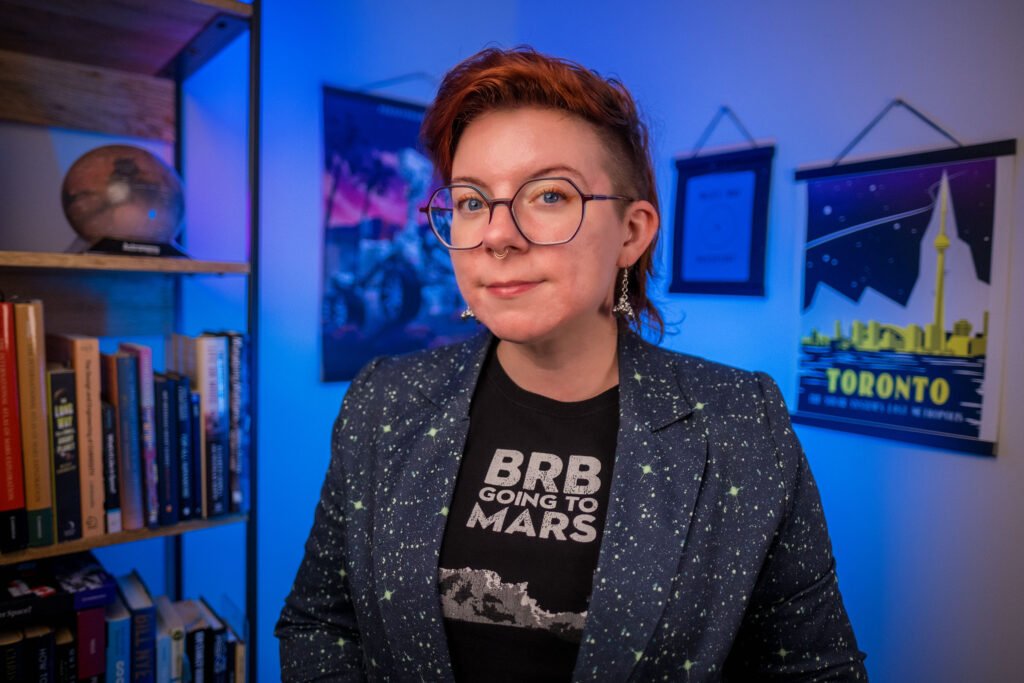
Dr. Tanya Harrison is a planetary scientist, future-focused science strategist, author, and one of the world’s go-to voices on Mars and space exploration. She holds a Ph.D. in Geology with a Specialization in Planetary Science and Exploration from the University of Western Ontario, a Masters in Earth and Environmental Sciences from Wesleyan University and a B.Sc. in Astronomy and Physics from the University of Washington. She is currently a Fellow of the Outer Space Institute and the Director of Earth and Space Science at the Canadian space company Mission Control, based out of Ottawa.